
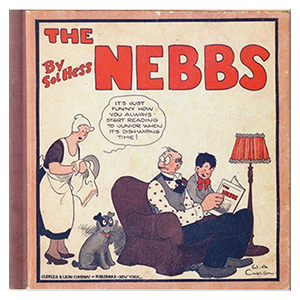

The
NEBBS
by Sol Hess and Wallace A. Carlson
A Domestic Comedy of Family Life, Social Ambition, and Missed Chances
Published by Cupples & Leon Company in 1928, The Nebbs collects episodes from the popular newspaper comic strip created and written by Sol Hess and illustrated by Wallace A. “Wally” Carlson. The collection presents the humor, social observation, and continuing storytelling that made the Nebb family familiar to newspaper readers of the period.
This particular volume turns much of its attention to Rudy Nebb’s wealthy cousin Ambrose, known as Amby. His efforts to establish a local hotel and court Sylvia create a sequence filled with romantic uncertainty, social embarrassment, neighborhood gossip, and disappointed ambitions.
Title
The Nebbs
Series
The Nebbs
Creator / Writer
Sol Hess
Illustrator
Wallace A. “Wally” Carlson
Publisher
Cupples & Leon Company
Publication Date
August 1, 1928
Language
English
Genre
Domestic Humor / Family Comedy / Newspaper Comic Strip
Format
Squarebound Comic-Strip Collection
Length
52 pages
Interior
Black-and-white
Cover
Color
About the
book
The Nebbs is a domestic-comedy comic strip centered on the everyday experiences of Rudy Nebb, his wife Fanny, their children Junior and Betsy, and the relatives, friends, and neighbors surrounding them.
Rudy is proud, talkative, and frequently more confident in his judgment than circumstances justify. Fanny serves as the practical center of the household, while Junior and Betsy bring their own youthful concerns and adventures into the family’s comic world.
The strip draws much of its humor from recognizable experiences involving money, family disagreements, romance, social ambition, employment, parenting, and the pressure to maintain appearances.
In this 1928 collection, the principal continuing sequence focuses on Ambrose and Sylvia. Ambrose’s plans for a local hotel unfold alongside his uncertain courtship, allowing the story to explore business ambition, self-consciousness, romantic misunderstanding, and the influence of a closely connected community.
Rather than functioning as a conventional prose novel, the narrative develops through consecutive newspaper strips, combining continuing situations with individual moments of comedy.