
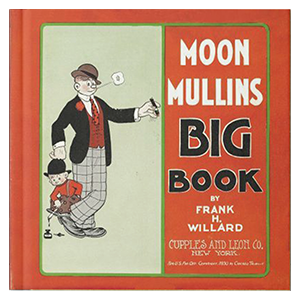

MOON MULLINS
BIG BOOK
by Frank H. Willard
Working-Class Ambition, Boarding-House Life, and Comic Misadventures
Published by Cupples & Leon Company in 1930, Moon Mullins Big Book is a substantial hardcover collection of Frank Willard’s popular newspaper comic strip. Across 136 illustrated pages, the volume presents the rough-edged humor and unconventional characters that defined the world of Moon Mullins.
Rather than telling one continuous novel-length story, the book collects comic-strip episodes centered on Moon, his younger brother Kayo, and the eccentric residents of Emmy Schmaltz’s boarding house. Their schemes, disagreements, financial troubles, and social ambitions create a lively mixture of domestic comedy, slapstick, and working-class humor.
Title
Moon Mullins Big Book
Series
Moon Mullins
Creator / Cartoonist
Frank H. Willard
Publisher
Cupples & Leon Company
Publication Date
June 1930
Place of Publication
New York, United States
Language
English
Genre
Humor / Working-Class Comedy / Newspaper Comic Strip
Format
Large Comic-Strip Reprint Collection
Binding
Hardcover
Length
136 pages
Approximate Dimensions
10 × 10 inches
Interior
Black-and-white
Cover
Color
About the
book
Moon Mullins Big Book collects the adventures of Moon Mullins, a rough but likable working-class character whose name is short for “Moonshine.”
Moon is a would-be prizefighter with dreams of money, comfort, and social success. Although frequently short of cash, he is rarely short of confidence. His attempts to improve his circumstances through schemes, gambling, fighting, romance, and questionable opportunities regularly create new complications.
Much of the series takes place in and around Emmy Schmaltz’s boarding house. This setting brings Moon into constant contact with an eccentric supporting cast whose competing personalities generate arguments, misunderstandings, domestic problems, and unexpected alliances.
Among the recurring characters is Moon’s younger brother Kayo, a small but remarkably tough and streetwise child. Kayo’s confidence and resourcefulness frequently reverse the expected relationship between the older and younger brothers.
The volume presents Moon’s world through collected newspaper strips rather than a conventional prose narrative. Because its individual contents have not been completely indexed, it is best understood as an anthology of humorous episodes rather than a single continuous adventure.