
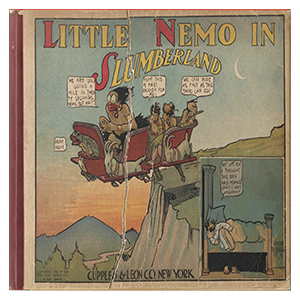
LITTLE NEMO IN
SLUMBERLAND
by Winsor McCay
An Extraordinary Journey Through the Imagination and Logic of Dreams
Published by Cupples & Leon Company in 1909, this large-format edition of Little Nemo in Slumberland collects Winsor McCay’s celebrated full-color newspaper comics. A documented complete copy contains 26 color plates, accompanied by a black-and-white title page.
The book follows a young boy named Nemo whose nightly dreams carry him into Slumberland, an extraordinary kingdom of magical palaces, strange creatures, impossible landscapes, and constant transformation. Each adventure combines fantasy storytelling with McCay’s inventive use of color, architecture, perspective, movement, and page design.
Title
Little Nemo in Slumberland
Creator / Writer / Artist
Winsor McCay
Publisher
Cupples & Leon Company
Place of Publication
New York, United States
Publication Year of This Edition
1909
Original Comic-Strip Debut
October 15, 1905
Original Newspaper
The New York Herald
Language
English
Genre
Fantasy / Children’s Fantasy / Adventure / Surreal Dream Fiction
Format
Large-Format Comic-Strip Collection
Dimensions
Approximately 10 × 14 inches
Printing
Full Color
Contents
26 full-color plates plus a black-and-white title page
About the
book
Little Nemo in Slumberland follows the dreams of Nemo, a young boy whose sleeping imagination transports him into an elaborate fantasy world.
In Slumberland, King Morpheus wants Nemo brought to his court to become a companion to the Princess. Reaching the royal palace, however, is rarely simple. Nemo’s journey is repeatedly interrupted by magical transformations, unusual creatures, enormous cities, moving beds, impossible staircases, and environments that change without warning.
Nemo eventually encounters recurring characters such as Flip, a mischievous cigar-smoking troublemaker whose hat carries the words “Wake Up.” Flip may serve as Nemo’s companion, rival, or the cause of another dream going unexpectedly wrong.
The stories frequently conclude when a frightening, surprising, or uncontrollable event causes Nemo to awaken in his own bed. This repeated movement between fantasy and reality gives the series its distinctive structure.
McCay designed the comic page as part of the dream itself. Panels stretch, shrink, collapse, or change shape as characters move through strange environments. Architecture, color, scale, and perspective contribute directly to the storytelling, allowing the reader to experience the shifting logic of Nemo’s dreams.