
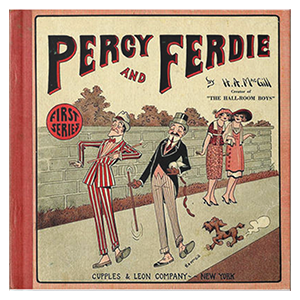

PERCY AND
FERDIE
by H. A. MacGill
A Comic Satire of Social Ambition, Appearances, and Empty Pockets
Published by Cupples & Leon Company in February 1921, Percy and Ferdie — First Series is a 52-page hardcover collection of H. A. MacGill’s newspaper comics. The documented on-sale date is February 25, 1921. Grand Comics Database
Rather than presenting one continuous story, the book contains dozens of short comic episodes featuring Percy and Ferdie—two fashionable but frequently penniless young men who are determined to convince everyone that they are wealthy, successful, and socially important.
Title
Percy and Ferdie
Series / Issue
First Series, No. 1
Creator
Harold Arthur MacGill
Publisher
Cupples & Leon Company
Place of Publication
New York, United States
Publication Date
February 1921
On-Sale Date
February 25, 1921
Language
English
Genre
Humor / Comedy / Social Satire / Newspaper Comic Strip
Format
Hardcover Comic-Strip Collection
Length
52 pages
Dimensions
Approximately 10 × 10 inches
Interior
Black-and-white
Cover
Color
About the
book
Percy and Ferdie — First Series collects short comic episodes built around two ambitious social climbers whose confidence is consistently much greater than their financial resources.
Percy and Ferdie present themselves as businessmen, actors, financiers, wealthy gentlemen, sophisticated travelers, and influential members of society. Their performances rarely last, however, because each new scheme eventually reveals that they have very little money or genuine status.
A recurring setting is the boarding house managed by Mrs. Pruhn, where the pair interact with other tenants and become involved in disputes concerning rent, food, heat, romance, and social appearances.
The collection begins with “Much Verbosity — Little Cash,” in which Percy and Ferdie have their shoes polished before discovering that they cannot afford to pay. Other episodes involve inspecting a house they cannot buy, losing a watch to a thief, going deep-sea fishing in a rowboat, working as shoe salesmen, pretending to be stockbrokers, posing as actors, and presenting themselves as powerful financiers. Grand Comics Database
The humor repeatedly comes from the contrast between the men’s exaggerated self-image and their actual circumstances. They want to live like wealthy gentlemen while struggling with ordinary expenses such as food, rent, clothing, and small bills.