
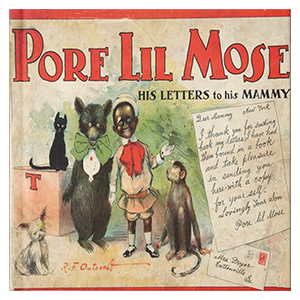

PORE LIL MOSE:
HIS LETTERS TO HIS MAMMY
by R. F. Outcault
An Early Collection of American Newspaper Comics
Originally issued in book form in 1902, Pore Lil Mose: His Letters to His Mammy collects illustrated newspaper cartoons created by Richard Felton Outcault. Cupples & Leon advertised an 80-page edition in September 1903 and issued another edition in September 1906. Surviving copies identify the Grand Union Tea Company as the publisher and carry a 1902 New York Herald copyright statement. Grand Comics Database
The collection follows Mose, a young Black boy from the fictional Southern community of Cottonville, through a series of comic experiences involving New York City, travel, school, animals, technology, money, and unfamiliar social situations. Many episodes are framed as letters or reports sent home to his family.
Title
Pore Lil Mose: His Letters to His Mammy
Original Book Publication
1902
Creator
Richard Felton Outcault
Cupples & Leon Edition
Advertised September 1903
Later Cupples & Leon Edition
September 1906
Original Publisher
Grand Union Tea Company, Brooklyn, New York
Copyright
New York Herald, 1902
Language
English
Genre
Humor / Satirical Newspaper Comics / Early American Comics
Format
Collection of Newspaper Cartoon Pages
Length
80 pages in the cataloged Cupples & Leon edition
About the
book
Pore Lil Mose: His Letters to His Mammy is a collection of short illustrated episodes rather than a conventional novel with one continuous storyline.
The cartoons originally appeared in the New York Herald around 1900 and 1901. The University of Central Florida’s archival description states that 36 of Outcault’s pages were gathered into the book. University of Central Florida Libraries
Mose’s adventures take him from Cottonville to New York, where he encounters unfamiliar places, people, inventions, and customs. The indexed contents include episodes involving a ghost story, burglars, school, animals, Central Park, Coney Island, an airship, a football game, and a visit to Thomas Edison.
Many episodes are presented through letter-like messages to Mose’s family. This structure connects the otherwise independent adventures while allowing each illustrated page to function as a separate comic situation.
The book also requires appropriate historical context. Although it is significant to the study of early American comics and the representation of Black characters in mass media, its imagery and dialect rely heavily on racist stereotypes and caricatures common in popular entertainment of its period. These elements may be offensive to contemporary readers. The material should therefore be presented as a historical work rather than an accurate or respectful representation of Black life.