
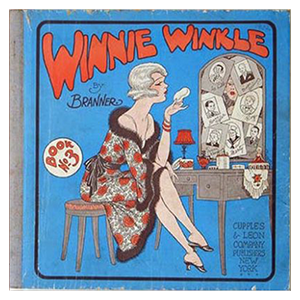

WINNIE
WINKLE
by Martin Branner
A Classic Collection of Working Life, Family, and Everyday Humor
Published by Cupples & Leon Company in 1933, Winnie Winkle — Book No. 4 is the fourth and final volume in the publisher’s four-book series of collected newspaper comics. The hardcover edition presents Martin Branner’s classic strip in a square 10 × 10-inch format, with a color cover and black-and-white interiors.
Centered on Winnie Winkle, a young woman working to help support her family, the comic blends workplace and domestic comedy with observations about independence, financial responsibility, relationships, and everyday American life. The wider series also features Perry Winkle and the Rinkydinks, whose mischief adds a lively counterpoint to Winnie’s adult responsibilities.
Title
Winnie Winkle
Book / Issue
No. 4
Series
Winnie Winkle — Cupples & Leon Series
Creator
Martin M. Branner
Publisher
Cupples & Leon Company
Publication Date
1933
Language
English
Genre
Humor / Workplace Comedy / Family and Social Comedy / Newspaper Comic Strip
Format
Hardcover Comic-Strip Collection
Dimensions
10 × 10 inches
Interior
Black-and-white
Cover
Color
About the
book
Winnie Winkle — Book No. 4 belongs to Cupples & Leon’s series of hardcover collections based on Martin Branner’s long-running newspaper comic strip.
At the center of the strip is Winnie, an independent young woman whose work helps sustain her household. Her employment, family obligations, friendships, and relationships provide the foundation for humor rooted in recognizable daily pressures.
The comic-strip format presents a sequence of illustrated episodes rather than a conventional prose novel. Workplace situations, domestic responsibilities, financial concerns, social expectations, and comic misunderstandings combine to create a portrait of early twentieth-century American life.
The exact sequence of newspaper strips reprinted in the 1933 volume is not fully documented in available public catalogs. For that reason, this description reflects the established characters and premise of the series without assigning an unsupported continuous plot to Book No. 4.