
How to Market Your Book Before and After Launch
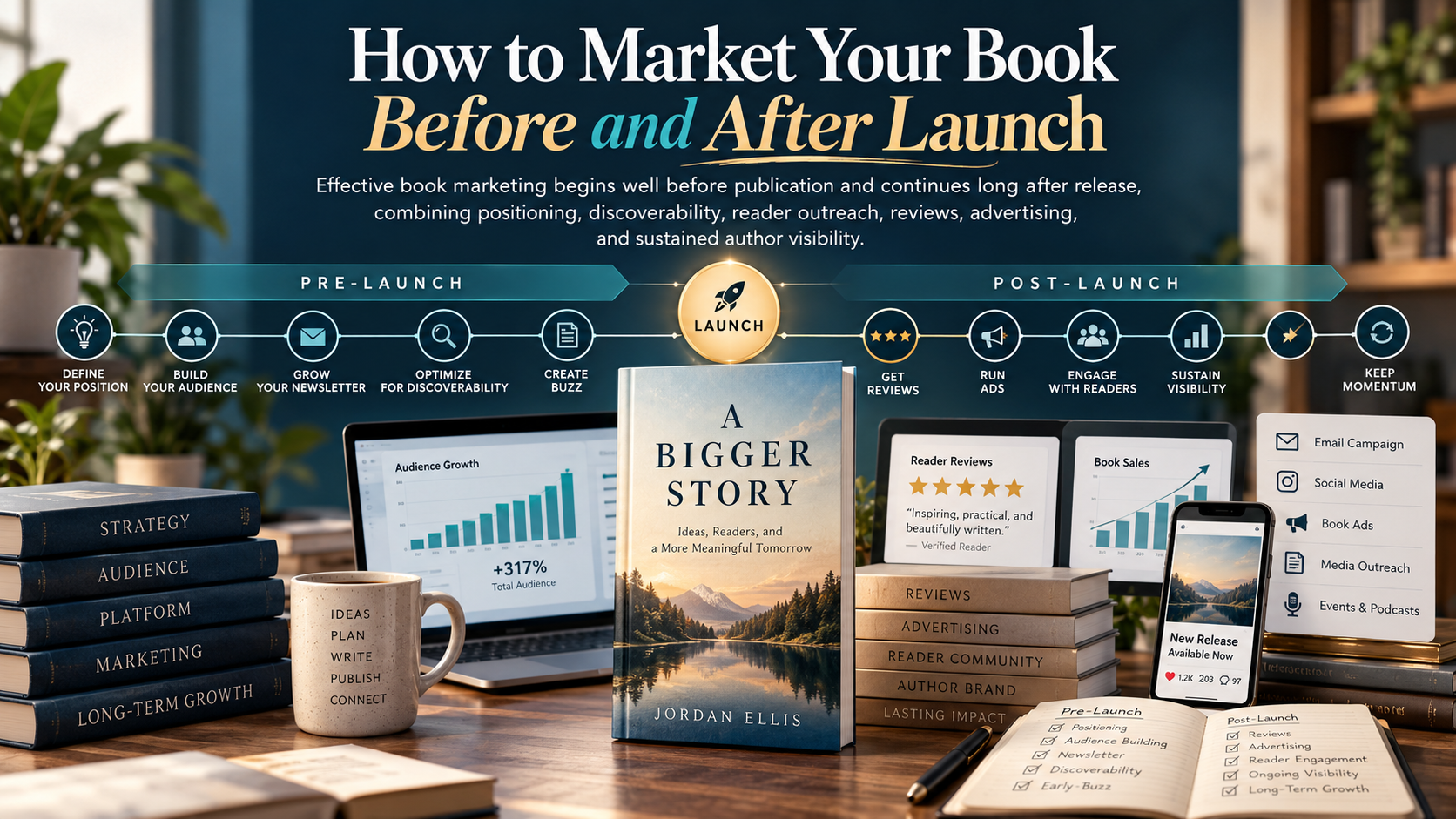
Effective book marketing begins well before publication and continues long after release, combining positioning, discoverability, reader outreach, reviews, advertising, and sustained author visibility.
Publication day attracts an outsized amount of attention in book marketing.
Authors plan countdowns, cover reveals, launch posts, interviews, promotions, and announcements around one date. The activity can create a welcome burst of visibility, but it can also encourage a misleading idea: that marketing begins shortly before release and succeeds or fails during launch week.
Publishing works on a longer timeline.
Readers may discover a book months before publication through advance copies, recommendations, search results, interviews, social media, newsletters, booksellers, or pre-orders. Other readers may encounter the same title six months later because a review, advertisement, event, topical news story, or related book brings it back into view.
The practical goal, therefore, is not simply to create a busy launch. It is to build a system that gives readers repeated, credible opportunities to discover the book before and after publication.
That system begins with positioning.
Start Marketing Before You Start Promoting
Book marketing and book promotion are related, but they are not identical.
Promotion is visible activity: advertisements, posts, interviews, giveaways, launch events, discounts, publicity, and outreach.
Marketing begins earlier. It asks:
Who is the book for?
What makes it distinctive?
Which books already serve that audience?
Where do those readers discover books?
How should the cover, description, metadata, price, positioning, and promotional language communicate with them?
A campaign built without these decisions often becomes a sequence of disconnected activities.
An author may post frequently without knowing which reader the content is intended to attract. Advertising may generate clicks but few purchases because the product page does not communicate the book effectively. Publicity may reach a large audience that has little interest in the subject or genre.
IngramSpark’s current marketing guidance emphasizes developing a marketing plan, defining the intended audience, establishing an author platform, and ensuring that online book information is accurate before the launch period intensifies. Its 2026 marketing timeline recommends treating marketing as a phased process rather than an activity that suddenly begins at publication.
The first useful marketing document is therefore not necessarily a social-media calendar.
It is a positioning brief.
At minimum, it should identify the book’s intended readers, core promise, genre or subject, comparable titles, principal selling points, available formats, publication date, marketing budget, and the channels most likely to reach the audience.
Build Discoverability Before You Build Hype
A reader cannot respond to a marketing campaign if the book becomes difficult to find, understand, or evaluate once the reader reaches the retail page.
That makes metadata part of marketing.
Metadata includes information such as the title, author name, book description, categories, keywords, publication information, and other data used by retailers and distributors to identify and display a title.
Amazon KDP states that book categories function like digital shelves and that authors can select up to three categories during title setup. Amazon also allows KDP authors to provide up to seven relevant keywords intended to improve discoverability.
IngramSpark likewise emphasizes accurate descriptions, subject classifications, audience information, and keywords as important components of discoverability. Its July 2026 metadata guidance specifically notes the importance of targeted keywords, subject categories, and a clear description in helping the appropriate readers find a title.
Before significant promotional spending begins, review the book’s retail presentation.
Does the cover communicate the correct genre?
Does the description make the central appeal understandable quickly?
Are the categories accurate?
Are the keywords specific enough to reflect what a relevant reader might actually search for?
Is the author name consistent across formats and platforms?
Are paperback, hardcover, and eBook editions correctly associated where applicable?
These details are not glamorous, but marketing can magnify whatever already exists. Sending more traffic to a confusing product page does not solve the confusion.
Use the Pre-Launch Period to Create Recognition
The purpose of pre-launch marketing is not to repeat “my book is coming” for several months.
It is to create familiarity.
Readers can be introduced gradually to the subject, themes, characters, research, author perspective, visual identity, or problem the book addresses. This gives promotional communication something to discuss besides the transaction itself.
A pre-launch content plan might draw from:
- the central themes or ideas in the book;
- carefully selected excerpts;
- the reason the book was written;
- research or historical context;
- character introductions for fiction;
- behind-the-scenes publishing material;
- questions the book addresses;
- early endorsements or editorial reviews where appropriate; and
- conversations with communities connected to the book’s subject.
The balance matters. If every message asks readers to buy or pre-order, the campaign can become repetitive before the book has even arrived.
The stronger approach is to build a body of relevant communication around the book and introduce purchase-oriented messages at appropriate points.
Consider Pre-Orders Strategically
For eligible Kindle eBooks, Amazon KDP currently allows a pre-order to be created as early as one year before release. The book receives an Amazon detail page during the pre-order period, giving authors a destination they can use in external marketing. KDP also notes that pre-orders can contribute to Kindle Store sales rank and merchandising before release.
That does not mean every author needs a year-long pre-order campaign.
A long pre-order period without meaningful promotional activity may accomplish little. The value comes from having a purchase destination while publicity, newsletters, advertising, reader outreach, or platform-building is already underway.
Authors should also understand the operational responsibility involved. KDP requires the final manuscript for a Kindle pre-order to be submitted more than 72 hours before the scheduled release date; failure to meet the deadline can trigger cancellation and restrictions on future pre-orders.
Treat a pre-order as a publishing commitment, not merely a marketing button.
Establish the Author’s Digital Home Base
Social-media platforms can be useful discovery channels, but an author’s online identity should not exist only inside one social network.
An author website can serve as the stable reference point for:
- the author biography;
- book information;
- retailer links;
- media information;
- event listings;
- contact details;
- articles or updates;
- newsletter registration; and
- future books.
IngramSpark recommends an author website as a central component of an author platform and describes the broader platform as the network of places where readers can discover and connect with the author.
Retailer-controlled author profiles should also be claimed where relevant.
Amazon Author Central allows authors to create an Author Page, associate books with it, add a biography, review certain sales and customer-review information, and monitor followers. Amazon’s Author Follow feature can also notify eligible followers about new releases or pre-orders under certain conditions.
Goodreads operates its own Author Program. Goodreads states that authors with published or soon-to-be-published books in its database may claim an author profile and gain access to profile management and promotional tools.
The point is not to create accounts everywhere.
It is to make sure the places readers are likely to check contain accurate, credible, consistent information.
Use Advance Copies Carefully and Ethically
Advance reader copies can support early awareness, reviews, endorsements, bookseller outreach, media pitches, and reader discussion.
They also require care.
An advance copy should not be treated as payment for praise.
Amazon KDP states that authors may provide free or discounted copies to readers, but they may not require a review in exchange or attempt to influence the review. Amazon further states that offering additional compensation such as gift cards can invalidate a review.
The Federal Trade Commission also requires material connections in endorsements to be disclosed when those connections could affect how consumers evaluate the endorsement. Its guidance specifically addresses situations in which a reviewer receives a free product.
For authors, a sensible ARC request is therefore simple:
Offer the book.
Invite honest feedback where platform rules permit.
Do not require a favorable rating.
Do not pay for supposedly independent consumer reviews.
Do not instruct readers what they should say.
Where a disclosure is required, make the relationship clear.
Early reviews can help a book establish credibility, but manipulated reviews create reputational and platform risk.
Treat Launch Week as Concentrated Visibility, Not the Finish Line
A launch works best when several existing activities converge.
The author’s audience has already heard about the book. Advance readers have had time to read. The website is live. Retail pages are accurate. Interviews or articles may be scheduled. Social content has context. Advertising has been prepared. Email subscribers know why the book matters.
Publication then becomes a reason to intensify communication.
Useful launch-period activity may include a release announcement, newsletter, interviews, podcast appearances, retailer advertising, live or virtual events, social content, community outreach, media pitches, partnerships, and reader-generated discussion.
Not every book requires all of these.
A regional history title may benefit more from museums, libraries, historical societies, local media, lectures, and specialist groups than from broad social advertising.
A romance novel may depend more heavily on genre communities, reader influencers, newsletters, Amazon visibility, series read-through, and Goodreads activity.
A business book may be marketed through speaking, professional associations, corporate sales, LinkedIn, podcasts, consulting networks, and subject-matter media.
The objective is relevance rather than maximum activity.
Use Advertising When the Retail Foundation Is Ready
Paid advertising can extend reach, but it should usually amplify a prepared book rather than compensate for weak positioning.
Amazon Ads currently offers Sponsored Products to eligible authors. These advertisements can appear in relevant shopping results and on product pages, with advertisers paying on a cost-per-click basis. Authors can target readers using relevant keywords and products and then review campaign reporting to refine performance.
Amazon also advises authors to start advertising early enough to allow for moderation and optimization and, around important selling periods, recommends ramping campaigns up in advance rather than switching them on at the last moment.
Advertising therefore benefits from experimentation.
Rather than treating a campaign as “running ads,” examine what is happening inside it.
Which keywords generate clicks?
Which comparable titles perform well as targets?
Which formats convert?
Does increased traffic produce sales?
Is the product description strong enough?
Is the price appropriate for the category?
Are ads profitable, break-even, or intentionally being used for reader acquisition?
Marketing decisions improve when they are based on observed behavior rather than impressions alone.
Email Remains Valuable Because the Relationship Is Direct
An email list gives an author a direct communication channel with readers who have chosen to hear from them.
It can support cover announcements, excerpts, pre-orders, launch messages, events, promotions, new editions, future releases, and ongoing author communication.
The list is most valuable when it remains useful between launches.
Authors who disappear for two years and then send six consecutive purchase requests are using email as an announcement system rather than a reader relationship.
A stronger newsletter may include reading recommendations, research notes, essays, behind-the-scenes material, event updates, or relevant commentary alongside promotional messages.
Commercial email also carries legal responsibilities. In the United States, the FTC’s CAN-SPAM guidance requires commercial messages to use accurate sender information and subject lines, provide a valid physical postal address, offer a clear opt-out mechanism, and honor qualifying opt-out requests within the required period.
Authors marketing internationally should also consider the privacy and electronic-marketing rules applicable to the jurisdictions in which their subscribers reside.
Post-Launch Marketing Is Where Books Build a Longer Life
The weeks after publication often reveal information that was unavailable before launch.
Which messages generated sales?
Which interviews drove traffic?
Which advertising targets converted?
Which posts prompted conversation?
Which reader groups responded unexpectedly well?
Which review language keeps appearing?
This is the point at which marketing should become more informed, not disappear.
IBPA’s recent marketing guidance explicitly frames book marketing across pre-publication, launch, and post-publication stages rather than treating release as the endpoint.
Post-launch opportunities can include additional publicity angles, seasonal campaigns, award submissions where appropriate, speaking opportunities, library and bookstore outreach, promotions, advertising optimization, reader-group engagement, podcast pitching, book clubs, educational use, corporate sales, and cross-promotion with later books.
A nonfiction book can regain relevance when its subject enters the news.
A holiday title can return each year.
A novel may gain new attention when a sequel appears.
A backlist book may become the entry point into an author’s entire catalog.
The commercial life of a book is rarely determined by one week unless the publishing strategy allows it to be.
A Marketing Strategist’s Perspective
One of the most common mistakes in author marketing is confusing activity with strategy.
Twenty social posts are activity.
A clear decision about which readers those posts are intended to reach, what message is being tested, what action the reader should take, and how the result will be measured is strategy.
The same distinction applies to publicity and advertising.
A podcast interview is not automatically valuable because the podcast has a large audience. It matters whether that audience overlaps meaningfully with the book.
A thousand website visits are not automatically better than one hundred if the smaller group contains more likely readers.
A high click-through rate is not enough if the retail page fails to convert.
Marketing becomes more efficient when every channel has a role.
Some activity creates awareness.
Some creates trust.
Some improves discoverability.
Some produces immediate sales.
Some builds an audience for the author’s next book.
Expecting every tactic to accomplish all five leads to poor evaluation.
Our Modern Books






Contact form
KEY
TAKEAWAYS
Begin before publication.
Make the retail foundation strong before buying attention.
Use reviews responsibly.
Measure channels according to their purpose.
Keep marketing after launch.
FINAL THOUGHTS
A publication date is an important milestone, but it is an arbitrary boundary from the reader’s perspective.
The reader who discovers a book six months after release does not experience it as an old marketing campaign. It is simply a book they have just found.
That distinction should shape the author’s strategy.
Build enough awareness before publication that launch day has context. Concentrate activity around release when there is a useful reason to do so. Then study what happens and continue investing in the channels that actually connect the book with interested readers.
The objective is not to make the loudest possible announcement.
It is to create repeated paths of discovery.
Books with durable marketing systems can continue finding readers long after the launch graphics have disappeared from the author’s social feed.