
Developmental Editing vs. Copyediting: What Does Your Manuscript Actually Need?
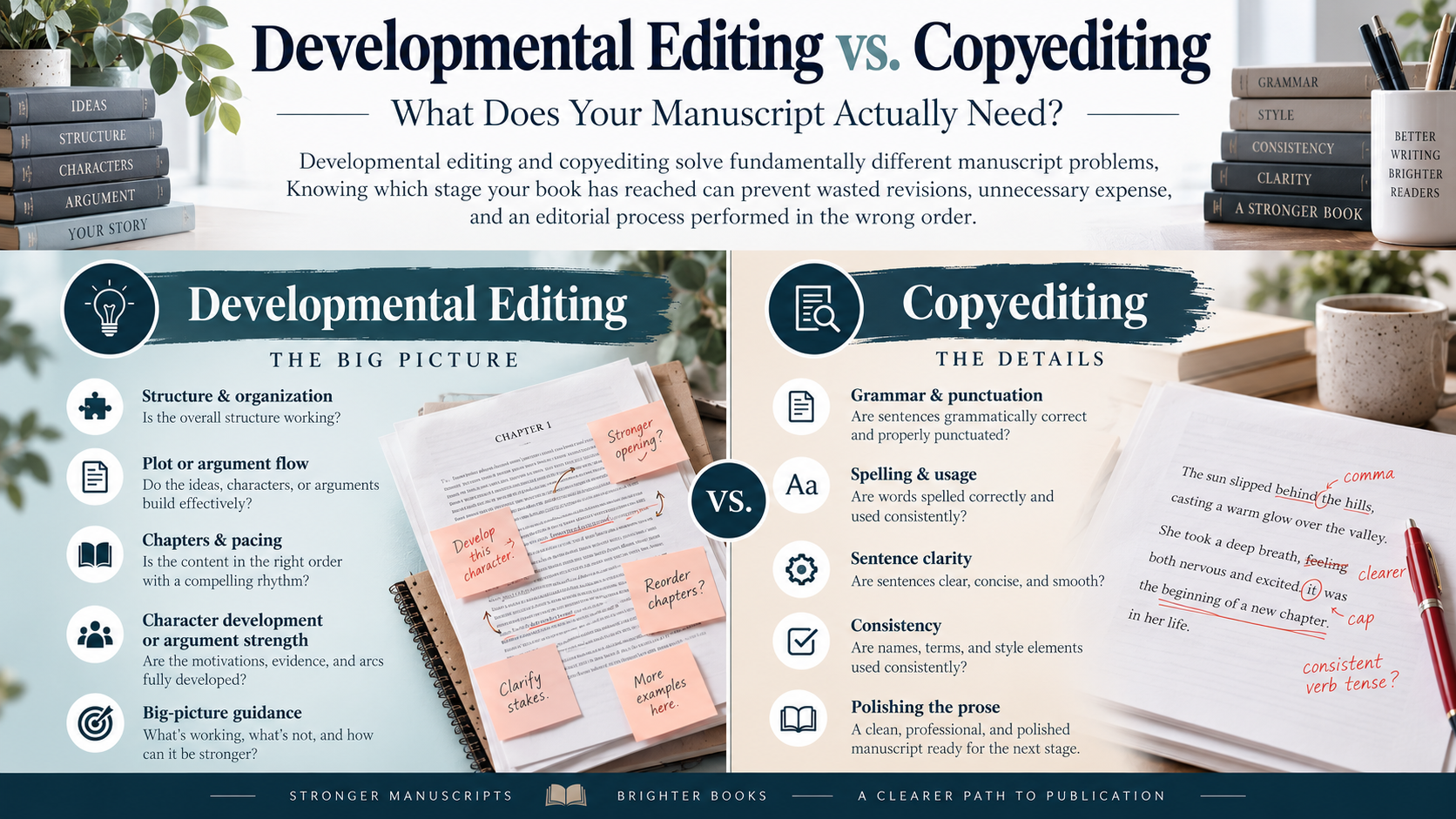
Developmental editing and copyediting solve fundamentally different manuscript problems. Knowing which stage your book has reached can prevent wasted revisions, unnecessary expense, and an editorial process performed in the wrong order.
The Editorial Freelancers Association defines developmental editors, also described as substantive, structural, or content editors, as professionals concerned with content, organization, and genre considerations. A developmental editor may provide a manuscript evaluation or a detailed editorial letter identifying major issues and recommending ways to address them.
Editors Canada’s Professional Editorial Standards 2024 uses the closely related term structural editing, defining it as assessing and shaping the overall organization and content of a work for its intended audience, medium, and purpose.
The terminology varies across publishing companies and individual editors, but the underlying principle is consistent: developmental work asks whether the manuscript functions effectively as a complete work.
For fiction, that may involve examining:
- plot architecture;
- character development and motivation;
- pacing;
- narrative point of view;
- stakes and conflict;
- chronology;
- world-building;
- chapter sequencing;
- opening and ending effectiveness;
- unresolved subplots; and
- genre expectations.
For memoir and narrative nonfiction, the questions may concern narrative focus, chronology, thematic development, repetition, scene selection, context, and the relationship between personal experience and the larger purpose of the book.
For prescriptive or informational nonfiction, developmental editing often examines the argument, chapter organization, audience, evidence, logical progression, repetition, missing information, and whether the manuscript delivers what its premise promises.
Editors Canada’s structural-editing standards specifically include reorganizing material, improving narrative or expository flow, recommending additions or deletions, addressing repetition and irrelevant material, identifying gaps, and questioning inadequate research or lack of focus.
That is a very different task from correcting commas.
Copyediting Works at a More Detailed Level
Once the content and organization of a manuscript are substantially settled, editorial attention can move closer to the sentence.
Editors Canada defines copyediting as reviewing material for correct and consistent grammar, punctuation, spelling, and usage, while also checking that required content elements are accurate and complete.
The Chartered Institute of Editing and Proofreading similarly places copyediting after developmental and stylistic work in the traditional publishing workflow. Its guidance describes copyediting as checking grammar, spelling, punctuation, consistency, clarity, formatting, cross-references, and other detailed elements once the content has largely been agreed.
A copyeditor may address questions such as:
Why is Chapter One written as words while later chapter numbers use numerals?
Is the character named Catherine, Katherine, or Kathryn?
Should the manuscript use “email” or “e-mail”?
Is Internet capitalized in one chapter and lowercase elsewhere?
Does the timeline still make sense after revisions?
Do quotations have appropriate attribution?
Does a cross-reference direct the reader to the correct chapter?
Are headings, lists, notes, citations, and recurring elements handled consistently?
In fiction, copyediting can include consistency checks involving character names, physical descriptions, dates, locations, fictional terminology, and chronology. CIEP specifically identifies these kinds of checks as part of copyediting practice.
The copyeditor is therefore doing far more than running a spelling checker.
The goal is to remove inconsistencies and language-level obstacles that may distract the reader or undermine confidence in the text.
The Simplest Distinction: Architecture vs. Execution
One useful way to understand the difference is to think of the manuscript as a building.
Developmental editing asks whether the rooms are in the right places.
Does the structure support what the building is meant to do? Is there a staircase where one is needed? Does one section dominate unnecessarily? Is an important component missing? Would changing the floor plan solve a larger problem?
Copyediting assumes that most of those architectural decisions have already been made.
Now the work becomes more detailed. Are the finishes consistent? Are labels correct? Are small defects creating friction? Do all of the individual elements work together cleanly?
The analogy has limits, but it illustrates why editorial order matters.
If a developmental edit leads an author to delete three chapters, combine two characters, rewrite the ending, reorganize half the nonfiction argument, or add 15,000 words, any detailed copyediting performed on the earlier version may have been partly wasted.
That is why professional editorial workflows generally move from large-scale intervention toward increasingly detailed review. Editors Canada’s standards distinguish structural, stylistic, copyediting, and proofreading stages, while recognizing that stages may overlap or be described differently in different projects.
Where Does Line Editing Fit?
The distinction becomes more complicated when line editing enters the conversation.
Line editing commonly occupies the territory between developmental work and traditional copyediting.
The Editorial Freelancers Association describes line editors as working primarily at sentence and paragraph level, with emphasis on improving language and style. Line editing may occur separately, alongside developmental editing, or in conjunction with copyediting.
Editors Canada uses the term stylistic editing for closely related work: clarifying meaning, improving coherence and flow at paragraph and sentence level, and refining language. It notes that line editing is often understood as a combination of stylistic editing and copyediting.
A line editor might focus on:
- repetitive sentence structures;
- overwritten or underdeveloped prose;
- unnecessary exposition;
- awkward transitions;
- unclear phrasing;
- dialogue that sounds unnatural;
- inconsistent narrative voice;
- weak paragraph flow;
- excessive wordiness; and
- language that fails to achieve the intended tone.
This explains why an author requesting “copyediting” may sometimes discover that the manuscript actually requires heavier sentence-level intervention.
Editorial terminology is not completely standardized across every publisher and freelancer. The safest approach is to look beyond the service label and examine the scope of work.
Ask what the editor will actually evaluate and change.
Developmental Editing Does Not Mean Rewriting the Book
Some authors hesitate to pursue developmental editing because they assume the editor will rewrite the manuscript into something unrecognizable.
That should not be the objective of professional developmental work.
A developmental editor identifies problems, explains why those problems affect the reader, and proposes possible solutions. The author may then carry out substantial revisions.
The degree of hands-on intervention depends on the agreement.
For example, an editor might observe that a novel’s central conflict does not become clear until Chapter 7 and recommend restructuring the opening. The editor might identify scenes that could be moved or compressed, but the author remains responsible for deciding how the manuscript should ultimately be rewritten unless rewriting is explicitly included in the service.
In nonfiction, an editor may conclude that Chapters 4 and 5 make substantially the same argument. The recommendation might be to combine them, redistribute supporting material, or sharpen the distinction between the chapters.
The developmental editor diagnoses the manuscript at the level where its largest problems exist.
That can mean asking difficult questions rather than supplying easy corrections.
Copyediting Cannot Repair a Developmental Problem
A skilled copyeditor may notice structural weaknesses, but a standard copyedit is not designed to reconstruct an entire manuscript.
Consider a mystery novel in which the murderer is revealed convincingly, the grammar is polished, and every comma is correct, but the clues necessary for the resolution appear only during the final chapter.
That is not fundamentally a copyediting problem.
Or consider a business book with beautifully written sentences that introduces its central framework in Chapter 9 even though Chapters 2 through 8 require readers to understand that framework.
Again, grammatical polish will not solve the underlying problem.
Editors Canada explicitly separates structural work involving organization, content, flow, additions, deletions, and focus from copyediting work centered on correctness and consistency.
This is why purchasing the least expensive or least invasive editorial service is not necessarily economical.
A manuscript can be professionally copyedited and still require extensive rewriting afterward. If that happens, much of the revised material may need another copyedit.
Editorial sequencing protects both the manuscript and the author’s investment.
How to Tell if You Need Developmental Editing
A manuscript is a strong candidate for developmental editing when the author’s uncertainty concerns the book itself rather than the correctness of individual sentences.
Warning signs include:
- you are unsure whether the opening works;
- beta readers become confused at the same point;
- the middle loses momentum;
- major characters seem underdeveloped;
- the ending feels disconnected from what preceded it;
- you suspect several chapters could be removed or reorganized;
- the manuscript has significant repetition;
- the argument lacks a clear progression;
- the intended audience is difficult to define;
- the book changes direction partway through;
- important information appears too early or too late; or
- you expect significant rewriting before publication.
Developmental editing is also appropriate when the author knows that something is wrong but cannot identify precisely what it is.
That outside perspective can be particularly valuable because authors know what they intended to place on the page. Readers encounter only what is actually there.
How to Tell if You Need Copyediting
A manuscript is more likely to be ready for copyediting when the author can confidently say that the structure, chapters, argument, plot, and major content are essentially finished.
At that point, the remaining concerns may include:
- grammar;
- punctuation;
- spelling;
- capitalization;
- word usage;
- consistency;
- terminology;
- continuity;
- factual plausibility;
- cross-references;
- tables and figures;
- citations;
- heading treatment;
- abbreviations;
- numbers; and
- adherence to a chosen style.
Editors Canada also includes identifying missing information, querying places where citations may be required, and flagging material that may require copyright acknowledgment among professional copyediting responsibilities when relevant to the project.
A copyeditor will frequently create or maintain a style sheet recording editorial decisions so that names, terminology, capitalization, punctuation preferences, numerals, and other recurring details remain consistent across the manuscript. CIEP likewise identifies the style sheet as an important part of copyediting communication and consistency control.
For a book-length manuscript, that consistency work can be as important as correcting obvious mistakes.
What if Your Manuscript Needs Both?
Many professionally published books do.
The question is not which service is “better.” The services address different stages.
A typical sequence might look like this:
Manuscript draft → developmental/structural editing → author revision → line/stylistic editing where required → copyediting → design and typesetting → proofreading
The exact workflow can change according to the project, budget, publisher, genre, and condition of the manuscript. Editors Canada explicitly recognizes that editorial stages can overlap or unfold differently, while CIEP describes developmental or structural editing, copyediting, and proofreading as distinct stages within a normal publishing workflow.
What should generally be avoided is reversing the logic without a reason.
Correcting every semicolon before deciding whether an entire chapter belongs in the book is rarely the most efficient use of editorial attention.
Proofreading Is Another Stage Entirely
Proofreading is frequently confused with copyediting.
It should normally occur later.
Editors Canada defines proofreading as examining material after its textual and visual elements have been laid out, correcting remaining errors and confirming that the design supports effective communication.
CIEP similarly describes proofreading as the final quality-control stage before material is published or shared with its audience.
At this point, the proofreader may check:
- typographical errors;
- incorrect page references;
- running heads;
- inconsistent headings;
- bad line or page breaks;
- missing text;
- spacing;
- captions;
- table-of-contents accuracy;
- formatting inconsistencies; and
- errors introduced during layout.
A proofreader should not ordinarily be restructuring chapters at this stage.
That would be comparable to changing the floor plan after the building has been furnished.
What Should You Ask Before Hiring an Editor?
Because terminology varies, service names alone should not determine the decision.
Before committing to an edit, clarify the scope.
Useful questions include:
What level of editing do you believe this manuscript needs?
Will you address structure and content, sentences and style, mechanical correctness, or a combination?
Will I receive an editorial letter or manuscript report?
Will changes be made directly in the manuscript?
Will edits be visible using Track Changes or another markup system?
Will you prepare a style sheet?
Does the service include fact-checking, citation review, or permissions review, or are those separate?
How will author queries be handled?
What happens after I complete revisions?
A sample edit can sometimes help establish expectations for sentence-level work. For manuscripts with uncertain structural needs, an editorial assessment may be more informative because a few sample pages cannot reliably reveal whether an entire novel’s pacing or a nonfiction book’s architecture works.
The scope should match the problem.
From the Editor’s Desk
Authors sometimes approach editing with a simple objective: make this manuscript cleaner.
Professional editing requires a more precise diagnosis.
If the manuscript’s fundamental structure is unstable, cleaning individual sentences can create the appearance of readiness without addressing the reasons the book is not yet working.
Conversely, repeatedly requesting developmental feedback after the structure has been settled can keep a manuscript in revision indefinitely when it should be moving toward copyediting and production.
The editorial process becomes more efficient when each stage has a stopping point.
Developmental editing asks whether the book works.
Line or stylistic editing asks whether the prose communicates effectively.
Copyediting asks whether the manuscript is correct, consistent, complete, and professionally controlled at the detailed level.
Proofreading asks whether the final produced version is ready to be released.
Once those distinctions are clear, authors can make better editorial decisions.
Our Modern Books






Contact form
KEY
TAKEAWAYS
Developmental editing addresses the large-scale manuscript.
Copyediting addresses detailed correctness and consistency.
Line editing occupies important territory between them.
Order matters.
Proofreading comes later.
FINAL THOUGHTS
The right question is rarely, “Is my manuscript good enough for an editor?”
A more productive question is: What problems am I asking the editor to solve?
If those problems concern plot, structure, chapter order, pacing, argument, missing material, or the overall effectiveness of the book, the manuscript is probably still in developmental territory.
If the book itself is settled but the language, consistency, mechanics, references, and details require professional control, it may be ready for copyediting.
And if both sets of problems exist, that is not unusual.
It simply means the manuscript has more than one editorial stage ahead of it.
Publishing becomes considerably more efficient when authors stop treating editing as a single correction pass and start treating it as a sequence of increasingly precise decisions.