
Why Book Launch Day Is Only the Beginning of Your Marketing Strategy
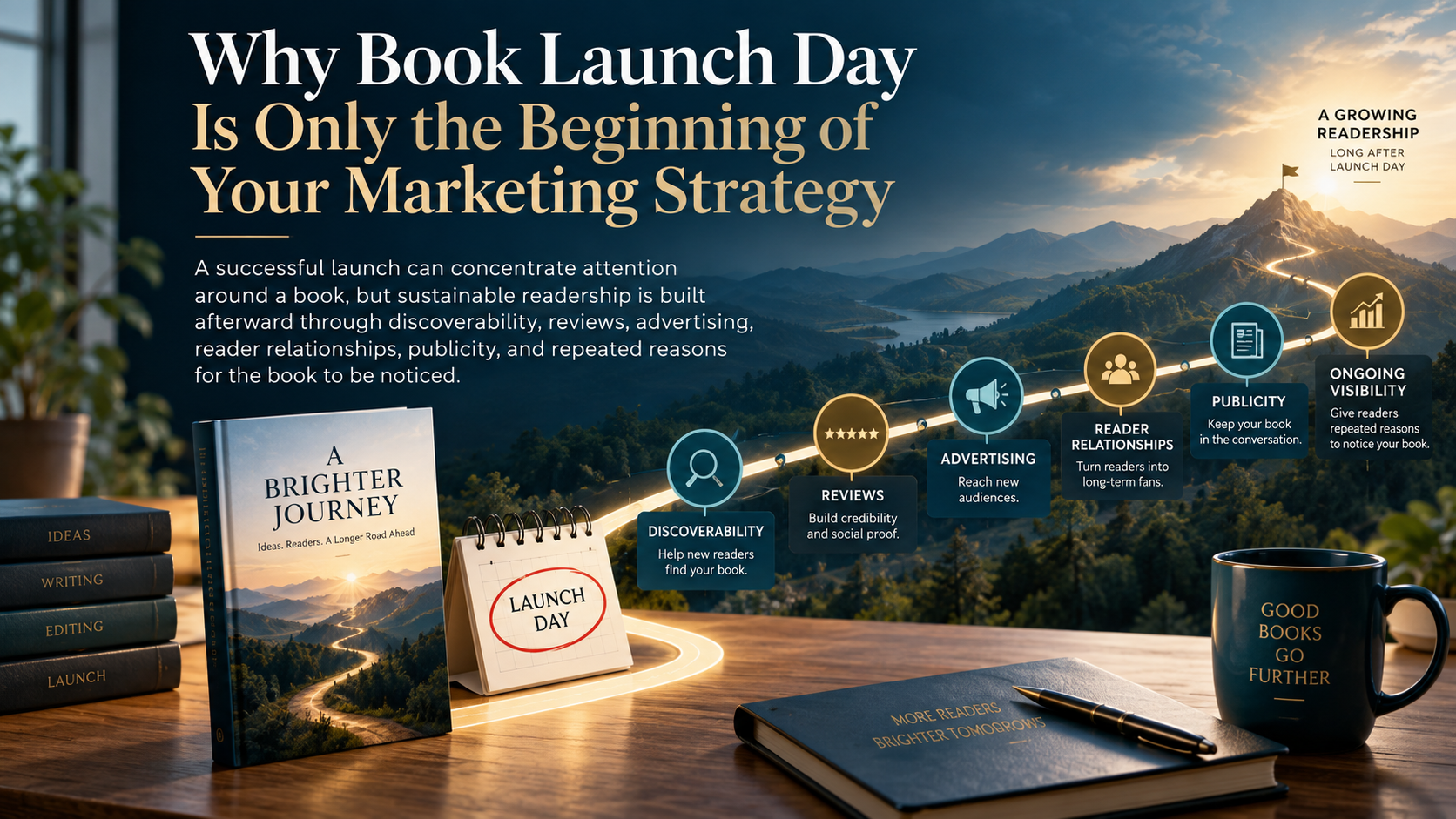
A successful launch can concentrate attention around a book, but sustainable readership is built afterward through discoverability, reviews, advertising, reader relationships, publicity, and repeated reasons for the book to be noticed.
Publication day feels like a finish line because so much work leads toward it.
The manuscript has been edited. The cover is complete. Print and digital files have been approved. Retail pages are live. Advance copies have gone out. Social posts are scheduled. Emails are prepared. After months or years of work, the book is finally available to readers.
From a marketing perspective, however, the publication date is better understood as a transition point.
IngramSpark’s 2026 book-marketing timeline explicitly separates release week from the post-release stage and advises authors to continue retailer outreach, follow up with contacts, develop audience relationships, and keep the book visible after publication. The broader goal, it notes, is steady sales over time rather than treating a brief ranking spike as the sole measure of success.
Amazon’s current advertising guidance makes the same distinction in operational terms: its author advertising resources identify separate uses for advertising during launch, for post-launch momentum, and for later backlist or series discovery.
A launch creates an event.
A marketing strategy creates a book that can continue being discovered after the event has passed.
Launch Day Concentrates Attention; It Does Not Create Permanent Visibility
Most launch activity is temporary by design.
A publication announcement is timely because the book has just appeared. A countdown works because a date is approaching. A launch event occurs once. A release-week interview or social-media campaign creates a short concentration of attention.
These activities can be valuable. The mistake is expecting them to carry the book indefinitely.
Readers do not all discover books on publication day.
One reader may encounter a title because a friend recommends it three months later. Another may hear the author interviewed on a podcast six months after publication. Someone searching Amazon may find it through an advertisement. A librarian may discover it through professional outreach. A news event may suddenly make a nonfiction subject relevant again.
For those readers, the book is new when they discover it, regardless of the date printed on the copyright page.
That creates one of the most useful principles in long-term book marketing:
A book needs more than one moment of discovery.
Launch week can create the first concentrated moment. The post-launch strategy creates the next ones.
The Launch Gives You Data You Did Not Have Before
Before publication, much of book marketing is based on informed assumptions.
You believe a particular audience will respond.
You select keywords you expect readers to use.
You choose comparable authors or books.
You decide which promotional message seems strongest.
You identify likely advertising targets.
Once the book is live, actual reader behavior begins providing information.
Amazon Ads, for example, gives authors campaign reporting that can be used to evaluate search terms, targeting, clicks, spending, attributed sales, and related performance. Amazon’s current author guide recommends continuing to optimize Sponsored Products campaigns after launch rather than treating them as fixed launch-only advertisements.
This changes marketing from prediction to refinement.
An author may discover that one keyword consistently attracts interested readers while another consumes budget without producing meaningful results.
A nonfiction writer may find that readers respond more strongly to a secondary subject in the book than to the original headline message.
A novelist may discover that a comparable title assumed to be an obvious advertising target performs poorly while a less obvious neighboring author converts better.
The post-launch period is therefore valuable partly because the book can finally teach you how the market is responding to it.
Instead of asking only, “How did launch week go?” ask:
What did launch week teach us that should change the next three months?
Advertising Can Become More Useful After the Initial Launch
Paid advertising is sometimes treated as a temporary launch mechanism.
Amazon’s own author guidance presents a broader use case.
Its current Sponsored Products guide explicitly identifies three stages for author advertising: launch, post-launch momentum, and series or catalog promotion. Sponsored Products can appear in Amazon shopping results and on relevant book-detail pages, with the advertiser paying when a reader clicks the advertisement.
That makes post-launch advertising fundamentally different from a launch announcement.
A launch message tells an existing audience that something has happened.
Search- and product-targeted advertising can continue putting the book in front of readers who are actively browsing relevant books and genres long afterward.
The strategy should become more selective as data accumulates.
Rather than simply increasing spending, authors can examine:
- which keywords produce meaningful sales;
- which books or categories work as productive targets;
- which campaigns attract clicks without converting;
- whether particular formats perform differently;
- whether advertising one book produces additional sales elsewhere in a series or catalog; and
- whether total sales justify the amount being spent.
Amazon currently encourages authors to review campaign performance regularly and continue optimizing targeting, bids, and budgets as campaigns develop.
The useful metric is therefore not “Are my ads running?”
It is “What are my ads teaching me about reader behavior, and am I adjusting accordingly?”
Reviews Accumulate After Publication
Reviews are another reason the marketing picture changes after launch.
Advance copies can generate early commentary, but many ordinary reader reviews can only accumulate after the book reaches a larger audience.
Amazon states that customer reviews help prospective readers understand what others think about a book and inform purchasing decisions. Its current policy permits authors to provide free or discounted book copies to readers, but authors may not require a review in return or attempt to influence its content. Offering additional compensation, such as gift cards, can invalidate the resulting review.
This means post-launch review strategy should focus on reader reach, not manufactured ratings.
Authors can continue making legitimate efforts to put the book in the hands of appropriate reviewers, reading communities, media professionals, bloggers, influencers, librarians, or other readers who may independently choose to discuss it.
Where a material connection exists, disclosure matters. Federal Trade Commission guidance states that endorsers should clearly disclose relationships that may affect how consumers evaluate an endorsement, including situations where a product was provided free or at a discount.
That distinction protects both the reader and the author’s credibility.
The objective is not to accumulate praise at any cost.
It is to increase the number of genuine readers encountering the book and allow legitimate reader response to develop around it.
Your Author Platform Becomes More Valuable After the Book Exists
Before publication, an author platform prepares people for a forthcoming book.
After publication, it gains another purpose: it becomes an ongoing route back to a book that is already available.
Amazon Author Central allows authors to maintain an Author Page, associate their books with it, add a biography, review certain sales and customer-review information, and see the number of Amazon followers. Amazon’s Author Follow feature can also notify eligible followers when qualifying new books become available or open for pre-order.
Goodreads operates its own Author Program, allowing eligible authors to claim profiles, manage information about themselves and their books, interact with readers, and use available promotional tools such as giveaways.
An author’s own website and email list serve another function: they are assets the author can continue developing between releases.
This becomes particularly important when the first book is not the last.
A reader who discovers Book One two years after publication can become a subscriber, follower, or repeat customer before Book Two arrives.
Seen this way, post-launch marketing is partly about selling the current book and partly about reducing the difficulty of launching the next one.
Every genuine reader relationship creates future publishing leverage.
Stop Repeating “Buy My Book” and Find New Reasons to Discuss It
One reason post-launch marketing becomes difficult is that the obvious message has already been used.
The book is out.
Followers know.
Repeatedly posting the cover with variations of “available now” eventually adds little.
The solution is not necessarily to post more. It is to create new editorial angles around the book.
A nonfiction author can discuss individual problems addressed in different chapters, respond to industry developments, explain research, publish practical excerpts, comment on related news, or connect the book to questions readers continue asking.
A memoirist can discuss themes surrounding the experience without repeating the entire personal narrative.
A novelist can highlight characters, setting, research, thematic questions, deleted material, reading recommendations, or the creative decisions behind the story.
A children’s author may connect the book to classrooms, holidays, family activities, educational themes, library programming, or seasonal reading.
This changes the book from a product that is repeatedly advertised into a source of subjects that can support sustained communication.
The distinction is important.
“Buy the book” is one message.
“Here is an idea worth thinking about that happens to lead naturally to the book” can produce dozens.
Publicity Has a Longer Calendar Than Publication Day
Media outreach is also frequently abandoned too quickly.
Some publicity opportunities need to happen before release, particularly trade-review deadlines and certain magazine or seasonal editorial calendars. But many other opportunities remain viable afterward.
Podcasts, newsletters, local media, professional associations, community organizations, blogs, conferences, speaking opportunities, topical commentary, and specialist publications may all have reasons to feature an author after the book is available.
IngramSpark’s 2026 timeline specifically recommends following up with contacts who did not respond before publication and continuing bookstore and other outreach after release.
IBPA likewise treats book marketing as a process that includes pre-publication, launch, and post-publication activity rather than a campaign ending on release day.
The strongest post-launch pitches usually have a reason beyond “the author has released a book.”
Consider:
Why is the subject relevant now?
Does the author have useful expertise connected to a developing story?
Is there a seasonal angle?
Has the book received meaningful recognition?
Is there a local connection?
Could the author contribute a useful essay or interview?
Does a conference, anniversary, holiday, cultural event, or industry development make the subject newly timely?
A book may be several months old while the story surrounding it is new.
That is often enough to create another publicity window
Bookstores and Libraries Can Remain Part of the Post-Launch Strategy
Authors sometimes assume that physical retail outreach is possible only before publication.
Early trade outreach can certainly matter, but post-release activity can remain useful, particularly at the local, regional, subject-specific, and community level.
IngramSpark recommends continuing to approach local bookstores after release and using established local demand to support those relationships. It also advises authors to revisit earlier strategies and follow up as the book gains sales history and credibility.
The approach should be professional.
Booksellers are evaluating commercial products, not simply supporting authors because they have written books.
An author approaching a store should understand the book’s format, retail price, wholesale availability, discount, returnability where relevant, audience, comparable titles, and evidence that local customers may be interested.
Libraries may care about different signals, including subject relevance, community demand, professional reviews, educational usefulness, local authorship, or collection needs.
Post-launch sales and reviews can sometimes strengthen these conversations because the author can now present evidence of reader response that did not exist before publication.
Seasonal and Topical Marketing Can Create New Mini-Launches
A publication date occurs once.
Marketing hooks can recur.
A romance novel may have opportunities around Valentine’s Day.
A book about grief may become relevant to particular awareness campaigns, professional discussions, or support communities.
A cookbook can connect to holidays and seasonal ingredients.
A leadership book may gain new relevance when workplace issues enter public discussion.
A historical title can be revisited around an anniversary connected to its subject.
A children’s title may fit back-to-school periods, summer reading, holidays, or classroom themes.
These do not require pretending the book is newly published.
They create a new reason to notice an existing book.
A disciplined author can build an annual calendar of such opportunities rather than inventing promotional activity week by week.
For some titles, these recurring moments can become more commercially useful than the original launch.
The Backlist Is an Asset, Not a Graveyard
The longer an author publishes, the more important post-launch strategy becomes.
A first book is a title.
Five books are a catalog.
Amazon Ads explicitly positions its author tools as useful for series promotion and backlist visibility, including opportunities to cross-sell between books.
This creates compounding effects.
A newly released Book Three can send readers back to Books One and Two.
A nonfiction author’s latest title can revive interest in an earlier book addressing a related issue.
A successful advertisement for one book can introduce readers to the author’s Author Central page and broader catalog.
A podcast appearance ostensibly discussing a new title may produce sales across several older books.
For authors who intend to publish more than once, the long-term objective should therefore extend beyond launch performance.
Build a catalog in which books can help market one another.
That is one reason a disappointing launch does not automatically mean a book has failed.
The book may still become commercially useful as the author’s platform, authority, reader base, and catalog grow.
Know What You Are Measuring
Post-launch marketing becomes much easier to manage when authors stop expecting every activity to produce immediate sales.
Different activities serve different purposes.
An advertisement may be evaluated through clicks, spend, attributed sales, and longer-term sales efficiency.
An email list may be assessed through subscriber growth, opens, clicks, and direct response.
A podcast appearance may primarily create awareness and reusable credibility.
A Goodreads presence may deepen reader connection.
A bookstore event may produce relatively modest direct sales while strengthening local visibility.
A speaking engagement may sell books while also creating professional opportunities unrelated to royalties.
The strategic question is:
What was this activity supposed to accomplish?
If the objective was awareness, measuring only same-day sales may undervalue it.
If the objective was direct conversion, a large number of impressions with no purchases should not automatically be celebrated as success.
Post-launch marketing improves when the author knows the role of each channel before deciding whether it worked.
From the Marketing Strategist’s Desk
Launch day is emotionally powerful because it is visible.
Post-launch marketing is less dramatic.
There may be no countdown. No celebratory graphics. No flood of congratulations. Progress may appear as a few new reviews, steadily improving ad targeting, another podcast appearance, a growing email list, an invitation to speak, a local bookstore order, or a reader discovering the book months after release.
Those smaller signals are easy to underestimate.
But durable book marketing is often built from accumulated attention rather than a single explosion of it.
The practical objective after publication is to find out which mechanisms continue creating discovery and then invest selectively in them.
Do not keep every launch tactic alive forever.
Keep the ones that still produce value.
Replace exhausted messages with new angles.
Use reader response to improve positioning.
Turn publicity into reusable assets.
Give existing readers reasons to stay connected.
And when the next book arrives, begin with the audience and knowledge the previous one created.
That is how a launch develops into an author strategy.
Our Modern Books








Contact form
KEY
TAKEAWAYS
Launch day is a milestone, not the marketing endpoint.
Launch day is a milestone, not the marketing endpoint.
Use post-launch data to refine the campaign.
Use post-launch data to refine the campaign.
Continue building reviews ethically.
Continue building reviews ethically.
Create new reasons to discuss the book.
Think beyond one title.
Create new reasons to discuss the book.
Think beyond one title.
FINAL THOUGHTS
The most important date in a book’s marketing life may not be its publication date.
It may be the day the right reviewer discovers it.
The week an interview introduces the author to a new audience.
The month an advertising campaign finally finds productive targeting.
The year a topical event makes the subject unexpectedly relevant.
Or the moment a new book sends readers back to everything the author published before it.
Launch day matters because it creates a focal point. It gives marketing a deadline, readers an event, and the author a reason to concentrate attention.
But a book designed to remain available for years deserves a marketing strategy longer than a week.
The better objective is not simply to launch strongly.
It is to continue creating legitimate reasons for the book to be discovered.