
ISBNs, Copyright, and Book Metadata: What Every Author Should Understand
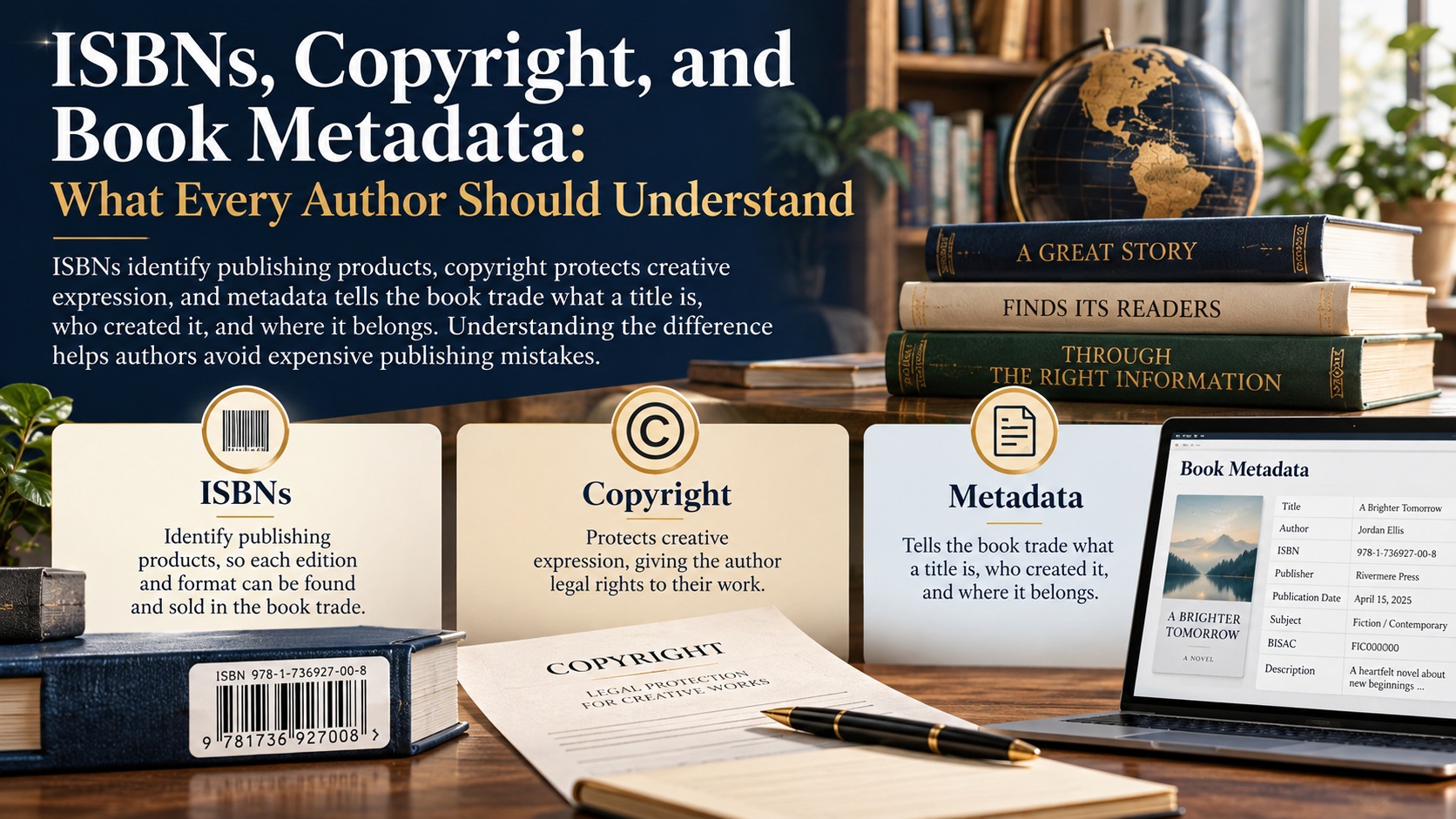
ISBNs identify publishing products, copyright protects creative expression, and metadata tells the book trade what a title is, who created it, and where it belongs. Understanding the difference helps authors avoid expensive publishing mistakes.
An ISBN does not copyright a book.
A copyright registration does not make a book easier for a retailer to categorize.
And carefully selected keywords cannot establish ownership of a manuscript.
These statements may seem obvious once the systems are separated, yet authors regularly encounter ISBNs, copyright notices, registration forms, categories, keywords, publisher names, descriptions, and distribution settings at roughly the same stage of publication. Because all of them appear around the administrative side of publishing, they can begin to look like parts of one process.
They are not.
An ISBN is principally an identifier for a particular publishing product. Copyright concerns legal rights in original expression. Book metadata is the body of information publishers communicate through the supply chain so that books can be identified, described, distributed, marketed, cataloged, and sold.
A professional publication needs these systems to work together without confusing their purposes.
The ISBN Identifies a Publishing Product
ISBN stands for International Standard Book Number.
ISBN.org, operated by Bowker as the official U.S. ISBN Agency, defines an ISBN as a 13-digit number that uniquely identifies a book or book-like product. Its purpose is to identify a specific title or edition from a specific publisher so that booksellers, libraries, wholesalers, universities, distributors, and other supply-chain participants can distinguish one publishing product from another.
The phrase specific publishing product matters.
A hardcover and paperback may contain exactly the same words, but they are different products. Under ISBN standards, different formats or bindings ordinarily receive different ISBNs. A revised edition also requires a new ISBN, and once an ISBN has been assigned and used for a publication, it cannot later be recycled for another book.
For example, an author planning:
- a paperback;
- a hardcover; and
- an ISBN-identified eBook edition
would ordinarily be dealing with three distinct product identifiers.
Platform rules can modify what is required in a particular ecosystem. Amazon KDP, for example, currently requires ISBNs for standard paperback and hardcover publication but does not require an ISBN for a Kindle eBook. This does not mean an eBook is incapable of having an ISBN; it means KDP does not require one for Kindle publication.
An ISBN Is Not a Copyright Registration
This is one of the most important distinctions an author can remember.
An ISBN identifies a book product in the publishing supply chain. Copyright protects qualifying original works of authorship.
The U.S. Copyright Office states that copyright protection begins when an original work is created and fixed in a tangible form of expression. ISBN assignment operates under an entirely different system.
Obtaining ten ISBNs therefore does not strengthen copyright protection ten times.
Likewise, publishing without an ISBN on a platform or product that does not require one does not mean the underlying manuscript lacks copyright protection.
The systems answer different questions.
ISBN: Which publishing product is this?
Copyright: What original expression is legally protected, and who owns the relevant rights?
Your ISBN Can Also Identify the Publisher of Record
An ISBN does more than distinguish one edition from another.
The ISBN structure and agency records also connect the identifier with a publisher.
ISBN.org explains that the publisher prefix identifies a specific publisher and warns against obtaining supposedly transferable ISBNs from unauthorized sources. An ISBN assigned from another publisher’s block will continue to identify that original publisher in industry records rather than automatically transferring publisher-of-record status to the author.
This becomes especially relevant for self-publishing authors deciding between a platform-provided identifier and their own ISBN.
Amazon KDP currently offers free ISBNs for eligible paperback and hardcover books. A KDP-provided ISBN can only be used through KDP, and its imprint is registered as “Independently published.” Authors who acquire their own ISBN through the appropriate ISBN agency can use their own registered imprint and can use that ISBN for the same eligible edition with other publishing services, provided all corresponding book and publisher information matches.
Neither option is automatically right for every author.
An author publishing one straightforward paperback primarily through Amazon may view the free identifier as sufficient.
An author building an independent publishing imprint, coordinating multiple distributors, or establishing a larger catalog may prefer to control the ISBN record directly.
The decision is about publishing infrastructure and identity, not copyright ownership.
An ISBN and a Barcode Are Also Different Things
These two are frequently used together, which creates another source of confusion.
ISBN.org states the distinction simply: an ISBN is a number; a barcode is the machine-readable graphic that encodes numerical information.
On a printed book, the ISBN commonly appears near or within the barcode on the back cover and may also appear on the copyright page.
The barcode helps retail systems scan the product.
The ISBN identifies the edition.
One is not a substitute for the other.
Copyright Exists Before the Copyright Page Is Designed
Authors sometimes delay thinking about copyright until they begin preparing the copyright page.
Legally, the copyright page is not what creates copyright.
Under U.S. law, the Copyright Office states that copyright protection attaches when an original work of authorship is fixed in a tangible medium. That includes both published and unpublished works.
A novelist therefore does not have to wait until publication day to have copyright in a qualifying manuscript.
Nor does an author need to place a copyright symbol on the first draft in order to create copyright protection.
For works first published on or after March 1, 1989, a copyright notice is no longer required under U.S. law to secure copyright protection, although the Copyright Office notes that using notice can still have legal benefits. A conventional notice usually includes the copyright symbol, year of first publication, and name of the copyright owner.
That makes the familiar line:
© 2026 Author Name
useful, but it should not be mistaken for registration itself.
Copyright Registration Is Different From Copyright Ownership
If copyright already exists, why register it?
Because registration creates additional legal and administrative advantages.
The U.S. Copyright Office’s current registration guidance explains that registration establishes a public record of a copyright claim and, when timely, may provide evidentiary and enforcement benefits. For U.S. works, registration or refusal is generally required before an infringement action can proceed in federal court. Timely registration can also affect eligibility for statutory damages and attorneys’ fees.
That produces a useful distinction:
Copyright ownership can arise automatically.
Copyright registration is a formal government record and enforcement tool.
Authors should also avoid assuming that copyright protects every element surrounding a book.
The Copyright Office notes that copyright does not protect ideas, methods, systems, facts, names, titles, short phrases, or slogans merely as such, although copyright may protect an author’s original expression of ideas or factual material.
A book title, for example, should not be treated as though registering the manuscript automatically gives the author copyright ownership over the title itself.
Other areas of intellectual property, including trademark law, may become relevant depending on how a name, phrase, series brand, or commercial identity is used.
Third-Party Material Creates a Separate Rights Question
Owning copyright in your manuscript does not automatically give you permission to reproduce material created by someone else.
Photographs, illustrations, maps, charts, song lyrics, lengthy quotations, artwork, and other third-party works may have separate copyright owners.
That means the publishing process should include a rights review where appropriate.
The practical question is not simply:
“Do I own my book?”
It is also:
“Do I have the necessary rights to everything I am placing inside this edition?”
For projects containing substantial third-party content or complex rights questions, qualified legal guidance may be appropriate.
Metadata Is the Book’s Commercial Identity
ISBNs help identify books, but the identifier alone tells a potential reader very little about why the book matters.
That is the job of metadata.
The Book Industry Study Group defines publishing metadata as the information publishers communicate through the global book supply chain. It is used by printers, distributors, retailers, libraries, educational institutions, and consumers and can include bibliographic, marketing, and commercial information. BISG also identifies ONIX as the international standard used to communicate book-industry product information electronically.
In practical terms, book metadata can include information such as:
- title and subtitle;
- author and contributor names;
- series information;
- ISBN;
- publisher or imprint;
- edition;
- publication date;
- format;
- language;
- page count;
- trim size;
- book description;
- subject classifications;
- categories;
- audience or reading age;
- keywords;
- territorial rights;
- pricing; and
- availability.
Some of these fields identify the book.
Others help sell it.
Others tell distributors how the product should move through the marketplace.
Together they create the book’s structured commercial identity.
Good Metadata Helps the Right Reader Find the Right Book
Metadata is administrative, but it is also marketing infrastructure.
IngramSpark’s July 2026 guidance emphasizes that accurate subject categories, targeted keywords, and a clear book description can improve discoverability by helping systems and readers understand what a title is about. BISG similarly describes metadata as the information that joins readers with books across the supply chain.
Amazon KDP provides a platform-specific example.
KDP currently allows authors to choose up to three categories for a title based on its audience and marketplace. It also permits up to seven keywords or short phrases intended to accurately reflect the book and the language customers may use when searching.
These fields should not be treated as opportunities to manipulate classification.
KDP specifically advises authors to select relevant categories and prohibits misleading metadata. It also recommends avoiding irrelevant author names, misleading terms, subjective claims such as “best novel ever,” time-sensitive promotional language, and other keywords that do not accurately describe the book.
The commercial principle is broader than any one retailer:
Accurate metadata is better than aggressive metadata.
If a historical biography is deliberately placed in an unrelated low-competition category merely to chase a ranking, the metadata is no longer doing its actual job.
Metadata should help the appropriate reader recognize the book.
Consistency Across Systems Is Essential
A surprisingly large number of publishing problems begin with minor inconsistencies.
One platform says:
Jonathan R. Williams
The ISBN record says:
Jonathan Williams
The copyright page says:
Jon R. Williams
The cover says:
R. Williams
To a human reader, these may obviously refer to the same person. Automated publishing systems may treat mismatches differently.
KDP states that authors using their own ISBN must ensure the title, author, and imprint information match the records held by the ISBN agency. Its production guidance also requires details such as title, author name, ISBN, imprint, and language to agree between title setup, cover, and interior files.
Consistency also helps multiple formats connect correctly. KDP attempts to link Kindle, paperback, and hardcover editions when core information such as title and author matches.
This is why professional publishers maintain a master metadata record.
The authoritative version of the title, subtitle, author name, imprint, description, identifiers, categories, publication date, and other key information should be decided before those details are distributed across dozens of systems.
Some Metadata Decisions Are Easy to Change; Others Are Not
Another reason to treat metadata seriously is that publication can lock important fields.
On KDP, descriptions, keywords, categories, territories, and pricing can currently be changed after publication. Other details, including language, edition number, ISBN choice, and many changes to title or primary author information, may require a new edition or otherwise become restricted once the title is live.
ISBN.org also states that a revised edition requires a new ISBN and that an ISBN already assigned to a published product cannot simply be reused.
That suggests a practical hierarchy.
A keyword can be tested and improved.
A description can be rewritten.
A price can be reconsidered.
An ISBN assignment, publisher identity, edition designation, or core title decision deserves more caution.
The earlier an author distinguishes flexible marketing metadata from structural bibliographic metadata, the fewer corrections will be required after publication.
A Practical Pre-Publication Metadata Record
Before uploading a professionally prepared book, create one authoritative document containing the final information for the edition.
At minimum, confirm:
Bibliographic identity
- exact title;
- exact subtitle;
- author name or pen name;
- contributors and their roles;
- series name and number;
- edition;
- language;
- publisher/imprint;
- ISBN for the specific format.
Product information
- format;
- trim size where applicable;
- page count when final;
- publication date;
- territories;
- price;
- distribution status.
Reader-facing metadata
- book description;
- short description if required by a distributor;
- subject classifications;
- retailer categories;
- audience or reading age where relevant;
- keywords;
- author biography.
Rights information
- copyright owner;
- copyright-registration status where applicable;
- third-party permissions;
- territorial rights;
- licensed material or contributor agreements where relevant.
Treat this record as the source of truth.
Do not reconstruct the information from memory every time a distributor, retailer, printer, designer, publicist, or metadata system requests it.
From the Publisher’s Desk
The administrative side of publishing is easy to underestimate because none of it feels as creative as writing the manuscript or designing the cover.
But these details can determine how efficiently a book moves through the publishing ecosystem.
An ISBN assigned to the wrong publisher cannot be repaired simply by changing the copyright page.
A copyright notice does not replace registration.
Registration does not fix inaccurate retailer metadata.
A brilliant description cannot compensate for the wrong title being attached to the ISBN record.
And a technically correct ISBN cannot help readers understand whether a book is historical fiction, a leadership guide, or a children’s picture book without supporting metadata.
The systems are strongest when each is allowed to do its own job.
Identifiers establish product identity.
Copyright governs protected expression and rights.
Metadata communicates the product to the marketplace.
Publishing administration becomes much less confusing once those boundaries are clear.
Our Modern Books





Contact form
KEY
TAKEAWAYS
An ISBN is a product identifier, not copyright protection.
An ISBN is a product identifier, not copyright protection.
Different formats normally require different ISBNs.
Different formats normally require different ISBNs.
Copyright generally exists automatically in qualifying original work under U.S. law once it is fixed.
Copyright generally exists automatically in qualifying original work under U.S. law once it is fixed.
Metadata is broader than keywords.
Consistency matters.
Metadata is broader than keywords.
Consistency matters.
FINAL THOUGHTS
Authors often think of publishing administration as what happens after the real creative work is finished.
That is only partly true.
ISBNs, rights records, and metadata may not shape the sentences inside the manuscript, but they shape the identity of the finished book once it enters the marketplace.
A reader may never consciously think about an ISBN.
A bookseller does.
A distributor does.
A library system does.
A reader may never use the word metadata.
Yet metadata influences what appears when that reader searches for a subject, browses a category, compares formats, reads a description, or checks who published the book.
And while a copyright notice may occupy only one line on the copyright page, the legal rights behind that line can affect licensing, enforcement, future editions, translations, adaptations, and the author’s ability to control the work over time.
Professional publishing therefore requires more than a finished manuscript.
It requires a book whose identity, ownership, and market information are all clearly established.