
Amazon Keywords and Categories: How Readers Actually Discover Books
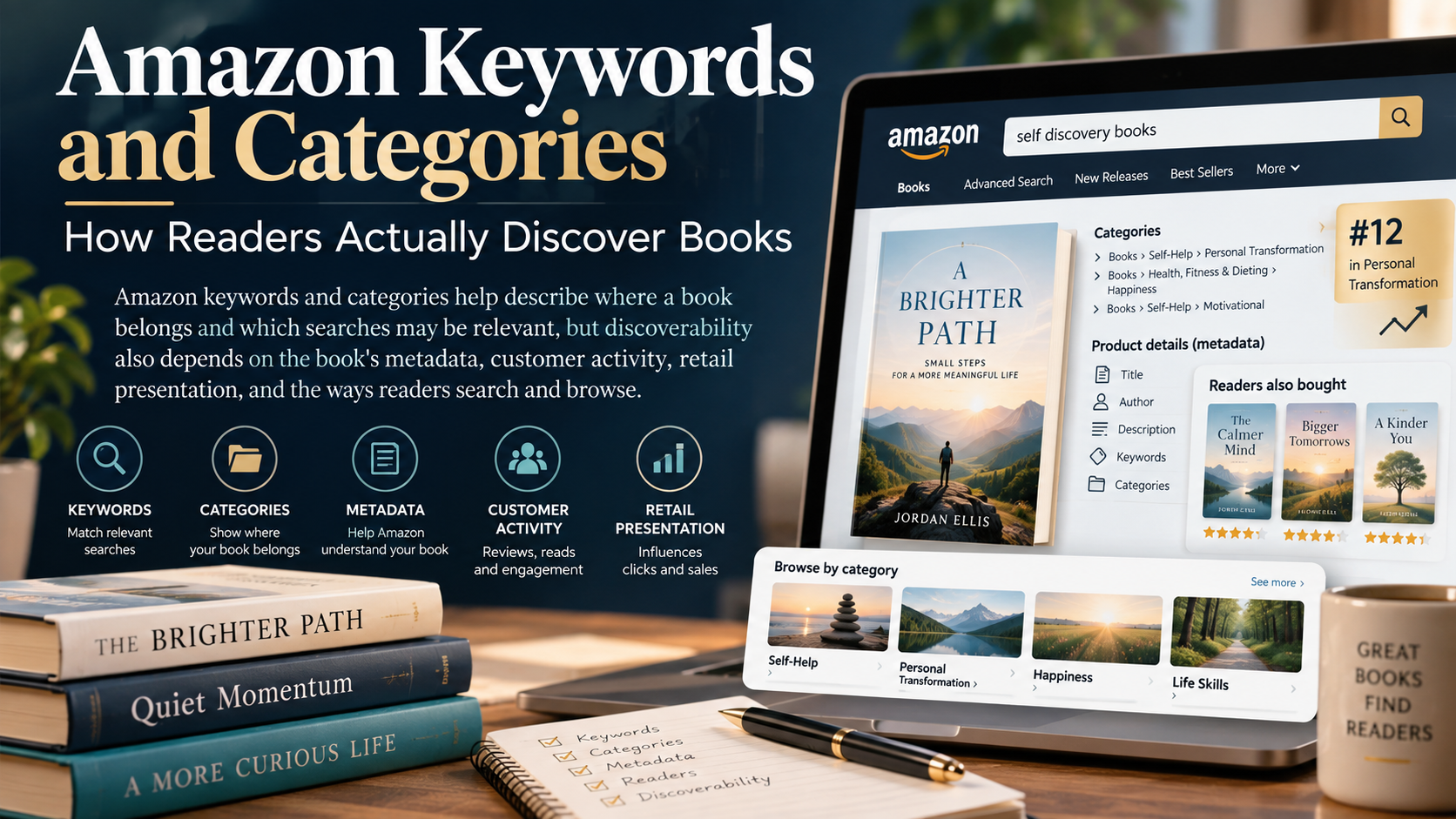
Amazon keywords and categories help describe where a book belongs and which searches may be relevant, but discoverability also depends on the book's metadata, customer activity, retail presentation, and the ways readers search and browse.
Authors often approach Amazon discoverability as though there is a hidden combination of seven perfect keywords and three perfect categories that can make a book appear at the top of search results.
Amazon’s own guidance describes a more complicated system.
Keywords matter. Categories matter. So do the title, author information, book details, the text associated with the book, sales history, customer activity, and other signals Amazon uses when presenting search results. KDP states that search results are dynamic and can change even when nothing about the book itself has been edited.
That makes discoverability less like entering a secret code and more like creating an accurate commercial identity for the book.
The purpose of metadata is to help the right reader and the right book encounter one another.
Understanding how keywords, categories, search results, bestseller rankings, and paid advertising differ is the first step toward doing that intelligently.
Readers Do Not Discover Books in Only One Way
Amazon is both a search environment and a browsing environment.
A reader may arrive knowing the exact title.
Another may search for an author’s name.
Someone else may enter a phrase such as:
historical mystery Victorian London
Another reader may browse through Historical Fiction, Psychological Thrillers, Personal Finance, Children’s Animals, or another category without entering a search phrase at all.
A reader may also encounter a book while looking at another title, through a sponsored advertisement, through an Author Page, through a bestseller list, or through Amazon’s broader merchandising and recommendation systems.
This is why “ranking for a keyword” should not be treated as the entire definition of Amazon visibility.
Different readers arrive through different discovery paths.
Good metadata prepares the book for several of them.
Keywords Help Amazon Understand Relevant Searches
KDP currently allows authors to enter up to seven keywords or short phrases for each book. Amazon advises authors to choose terms that accurately describe the content and reflect words customers may use when searching.
The important phrase is what customers may use.
An author naturally thinks in manuscript language.
A reader thinks in shopping language.
Suppose a novel is described by its author as:
A multigenerational exploration of belonging, inherited memory, and displacement.
Those themes may be accurate, but a reader could search more concretely for:
immigrant family saga
multigenerational literary fiction
family secrets novel
historical family drama
The strongest keyword research tries to bridge those perspectives.
KDP suggests useful keyword concepts including:
- setting;
- character types;
- character roles;
- plot themes; and
- story tone.
For nonfiction, useful terms may instead describe the problem, audience, subject, profession, method, or situation addressed by the book.
A guide for new managers, for example, might explore relevant language around:
first time manager
managing difficult employees
leadership for new managers
delegation skills
The objective is not to predict every possible query.
It is to give Amazon accurate additional context that may not already appear clearly in the title, subtitle, or categories.
Relevance Matters More Than Keyword Volume
One of the easiest mistakes is trying to make a book appear in as many searches as possible.
That sounds attractive until those searches involve readers who do not want the book.
Amazon explicitly prohibits inaccurate or misleading keywords. Its current metadata guidance warns against using unrelated terms, other authors’ names, other authors’ books, promotional claims such as “free,” sales-rank language, and other metadata intended to manipulate discovery.
KDP also advises authors not to waste keyword space repeating information already represented elsewhere, such as obvious category terms or book-title information.
This suggests a more useful principle:
Use keywords to add information, not duplicate it.
If the book is already categorized under nineteenth-century history, repeating that exact category wording as a keyword may contribute less than a more specific concept related to the book’s actual subject.
For fiction, that could be a trope, setting, relationship type, mood, or character archetype.
For nonfiction, it might be a reader problem, occupation, use case, or specific topic.
Specificity helps Amazon understand who might reasonably be interested.
Categories Are Digital Shelves
KDP describes Amazon book categories as digital shelves similar to sections in a physical bookstore.
Authors can currently select three categories during KDP title setup. Amazon states that categories and keywords together help determine where a book is “shelved” in the store.
This is a different function from keywords.
A keyword may respond to a specific search concept.
A category places the book inside a broader browsing context.
For example, a Victorian romance might potentially belong within areas such as historical fiction and historical romance. Someone browsing those sections is already signaling an interest in that type of book.
The category choice should therefore answer a practical question:
Where would the reader most likely expect to find this book?
That is more useful than asking:
Which category looks easiest to rank in?
Amazon specifically advises authors to research their genres, select accurate categories, and balance relevance with category breadth. It also warns that deliberately inaccurate categorization creates a poor customer experience and may be changed by KDP.
A marketing strategy based on misclassification may produce a temporary ranking screenshot while doing very little to connect the book with genuine readers.
Categories Differ by Marketplace and Format
Amazon’s category system is not one permanent global list.
KDP states that category availability can vary by marketplace and by format. A category available for an eBook may not necessarily appear in the same way for a paperback, and categories available on Amazon.com may differ from those available in other national Amazon stores. Amazon also updates categories over time.
This matters for authors publishing internationally or across several formats.
A category strategy developed for the U.S. Kindle Store should not automatically be assumed to apply unchanged to print editions or another marketplace.
The correct approach is to examine the primary marketplace and available categories for the particular format being configured.
KDP also notes that primary-audience settings can affect category eligibility, especially for Children’s and Teen & Young Adult books.
Metadata works as a system.
Category, audience, marketplace, format, keywords, and book details should reinforce one another.
Amazon Search Is More Than the Seven Keyword Fields
Another misconception is that the seven KDP keyword fields alone determine whether a book appears in search.
Amazon says otherwise.
Its current search guidance explains that search results can be influenced by information that is not always visible on the results page, including:
- keywords;
- book details; and
- the text associated with the book.
KDP’s keyword guidance further states that relevant keywords can help search placement alongside factors such as sales history and Amazon Best Sellers Rank.
This is important because it explains why two books using similar keyword language do not necessarily appear in the same positions.
Metadata helps Amazon understand relevance.
Customer activity provides another kind of signal.
The precise search-ranking system is proprietary and dynamic, so authors should be cautious of anyone claiming to know a guaranteed formula for placing a book permanently at a specific organic search position.
Amazon itself states that a title appearing on the first page today is not guaranteed to remain there tomorrow.
Search visibility is a moving outcome, not a permanent metadata setting.
Search Ranking and Bestseller Ranking Are Different
The language around Amazon rankings can become confusing because several different concepts are often discussed together.
A book may appear:
- in search results;
- within a category;
- on a category bestseller list; or
- with an overall Amazon Best Sellers Rank.
These are not interchangeable.
KDP states that Best Sellers and Category Ranks are based on customer activity relative to other books. Rankings consider both recent and historical activity, with recent activity weighted more heavily.
A book can currently display rankings in up to three Best Seller Category lists, regardless of how many places it may otherwise appear within Amazon’s category structure.
This means selecting a category does not automatically create a strong category rank.
The category tells Amazon where the book belongs.
Customer activity influences how the book performs relative to other titles there.
That is an important strategic distinction.
Authors should choose categories for reader relevance, then use marketing to generate legitimate reader activity.
Trying to reverse that logic by choosing irrelevant categories purely because they appear less competitive misunderstands the purpose of the system.
The Title and Author Name Are Also Discovery Metadata
Keywords attract a great deal of attention because they feel adjustable.
But some of the strongest discovery information is already visible on the book.
KDP describes the title as one of the most frequently used search attributes. Amazon also emphasizes consistent author naming because Author Pages, series pages, linked formats, and customer searches rely on that information.
This has practical consequences.
If one book uses:
Michael R. Daniels
and the next uses:
R. Daniels
Amazon may not automatically treat those identities as interchangeable in every context.
The same principle applies across paperback, hardcover, and eBook versions. KDP recommends matching core book details across formats so they can be linked correctly on the same Amazon detail page.
Metadata consistency is part of discoverability.
Authors who obsess over hidden keywords while ignoring inconsistent names, subtitles, series information, or format metadata may be optimizing the least visible part of a larger problem.
Categories Are Not the Same Thing as BISAC Codes
Authors distributing books beyond Amazon may encounter BISAC Subject Headings.
These should not automatically be confused with the categories selected in KDP.
The Book Industry Study Group identifies BISAC as the U.S. publishing industry’s standardized subject-classification system. Publishers use BISAC headings to communicate a book’s subject to distributors, retailers, libraries, and other trading partners. Retailers may then map those codes into their own internal category structures.
Amazon’s customer-facing category system is its own retail structure.
The relationship between industry subject codes and retailer categories can therefore involve mapping rather than exact one-to-one equivalence.
This matters when an author asks:
“My distributor lists my book under this BISAC. Why is the Amazon category called something different?”
The answer may simply be that the retailer organizes customer browsing differently from the standardized subject data received through the publishing supply chain.
Both systems help classify the book.
They are not necessarily identical systems.
Organic Keywords and Advertising Keywords Are Also Different
Another common source of confusion involves Amazon Ads.
The keywords entered in KDP’s book-details section are metadata keywords intended to help describe the book and support organic discovery.
Advertising keywords operate inside Amazon Ads campaigns.
They are related concepts, but they are not the same field and do not serve exactly the same function.
With Sponsored Products, authors can use keyword targeting to match advertisements with relevant shopping queries. Amazon Ads also offers product targeting, allowing advertisers to target specific books or categories.
Sponsored Products may appear in shopping results and on relevant book-detail pages, and advertisers generally pay when a shopper clicks.
Advertising therefore adds a paid discovery layer.
A reader searching for:
vegetarian cookbooks
might encounter organic results selected by Amazon’s search systems and sponsored placements from advertisers targeting that query or related products.
The word keyword is used in both contexts, but one belongs to the book’s metadata and the other belongs to paid campaign targeting.
Authors should evaluate them separately.
Advertising Data Can Improve Your Understanding of Reader Language
One advantage of Amazon Ads is that campaign data can reveal how readers actually search.
Amazon provides reporting for Sponsored Products, including search-term and targeting information that can help advertisers evaluate which keywords, products, and categories generate impressions, clicks, and sales.
This can produce valuable market insight.
An author may discover that readers respond to terminology different from the wording used in the original marketing plan.
A nonfiction author may believe the book is primarily about “executive communication” but find that readers respond more strongly to “difficult workplace conversations.”
A fantasy author may think “epic fantasy” is the central positioning phrase while stronger results emerge around a more specific trope or comparable-reading experience.
Advertising data should not be copied blindly into metadata.
But it can reveal how real shoppers describe their interests.
That makes post-publication optimization more evidence-based.
Research Keywords Like a Reader
KDP explicitly recommends thinking like a customer and testing prospective search language directly on Amazon before publication. Amazon suggests examining the autocomplete suggestions that appear as searches are entered and evaluating whether the resulting books are actually relevant.
That creates a practical research method.
Begin with the book’s factual identity:
Genre: What kind of book is it?
Subject: What is it about?
Audience: Who is it for?
Setting: Where and when does it occur?
Characters or roles: Who is central?
Themes or problems: What does it explore or solve?
Tone: What kind of reading experience does it offer?
Then translate those answers into reader language.
For a thriller, “post-traumatic identity reconstruction” may accurately describe a theme but probably does not resemble the first search phrase most thriller readers will enter.
“Psychological thriller memory loss” may be closer to shopping language.
For a practical nonfiction title, “strategic organizational interpersonal effectiveness” may sound impressive while “how to manage difficult employees” may describe the actual reader problem.
Professional metadata often involves choosing the clearest language rather than the most sophisticated language.
Research Categories Through Comparable Books
Category research also benefits from studying the marketplace.
KDP itself recommends examining similar books and seeing how relevant genres and subgenres are represented.
The purpose is not to copy a successful competitor.
It is to understand reader expectations.
If ten genuinely comparable books appear within the same narrow category and your manuscript satisfies that category’s definition, the pattern is useful evidence.
If you need to explain at length why your book technically qualifies for a category that no comparable title seems to use, the match may be weaker than it appears.
Category research should answer:
Which digital shelf contains the books my ideal reader already buys?
That question keeps the strategy centered on readers instead of rankings.
Do Not Over-Optimize the Metadata
An author can spend an extraordinary amount of time adjusting seven keyword fields.
There is a point of diminishing returns.
Metadata cannot compensate for a book whose cover communicates the wrong genre.
It cannot repair an unclear title.
It cannot make an unconvincing description persuasive.
It cannot generate customer demand on its own.
And it cannot guarantee stable search placement.
The book-detail page works as a complete commercial unit.
A reader may discover a title through a keyword, but the cover determines whether they stop.
The title helps them understand it.
The description deepens interest.
Reviews may influence confidence.
Price affects the decision.
The sample demonstrates the writing.
Marketing creates additional traffic.
Metadata gets the book into relevant conversations. The rest of the publishing package has to convince the reader to continue.
From the Marketing Strategist’s Desk
The weakest Amazon metadata strategies usually begin with the question:
How do I get the algorithm to show my book more often?
A better question is:
How do I help Amazon understand which readers are most likely to consider this book relevant?
The difference is subtle but important.
The first mindset encourages manipulation: chase an easy category, borrow another author’s name, stuff the keyword fields, or search for loopholes.
The second encourages accurate positioning.
If a book is a cozy culinary mystery set in New England, say so through the metadata.
If it is a practical guide for parents managing childhood food allergies, describe that clearly.
If it is a scholarly history of nineteenth-century maritime trade, resist the temptation to put it in broad popular-history categories simply because they appear more active.
Accuracy gives Amazon better information.
It also gives the reader a more coherent experience from search query to product page.
Discoverability works best when the metadata, cover, description, category, audience, and actual content all tell the same story.
Our Modern Books








Contact form
KEY
TAKEAWAYS
KDP currently provides up to seven keyword fields and three category selections.
KDP currently provides up to seven keyword fields and three category selections
Keywords are only one search signal.
Keywords are only one search signal.
Categories should represent genuine reader expectations.
Categories should represent genuine reader expectations.
Search position is not the same as bestseller rank.
Advertising keywords are separate from KDP metadata keywords.
Search position is not the same as bestseller rank.
Advertising keywords are separate from KDP metadata keywords.
FINAL THOUGHTS
Amazon discoverability is sometimes presented as a technical puzzle.
It is more useful to think of it as a positioning problem.
The reader has an intention, even if that intention is only vaguely expressed through a search phrase or a category they choose to browse.
The book has an identity.
Metadata creates the bridge between them.
Keywords describe specific aspects of that identity. Categories place the book within recognizable reading interests. Titles, author information, descriptions, and other details add context. Customer activity affects rankings and visibility. Advertising can introduce the book into additional relevant searches and browsing environments.
No single field carries the entire burden.
That is good news for authors.
It means Amazon visibility does not depend on discovering one magical keyword.
It depends on something more durable: describing the book accurately enough that the people searching for that kind of book have a reasonable chance of finding it.