
Traditional Publishing, Self Publishing, or Assisted Publishing: Which Path Fits Your Book?
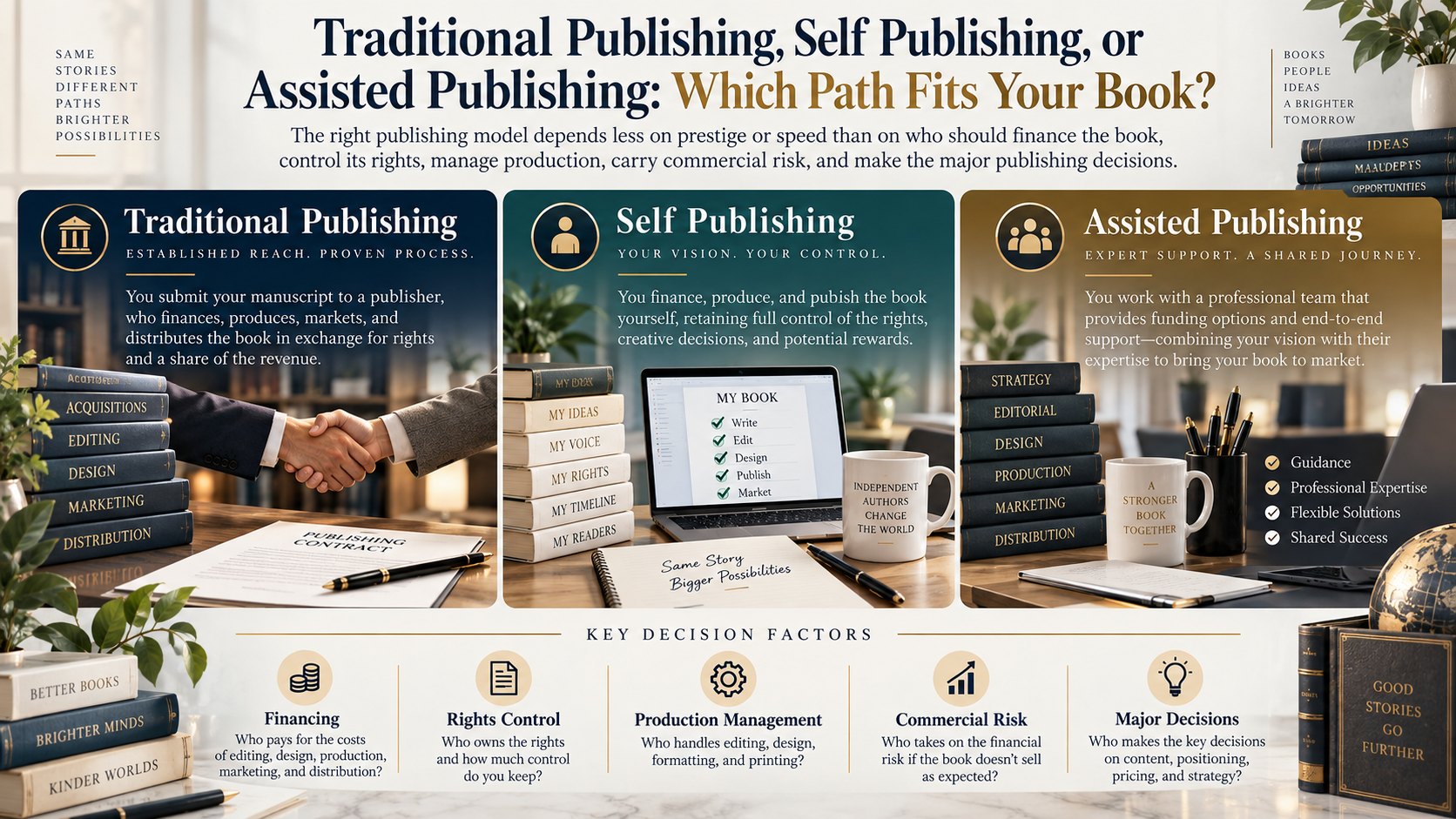
The right publishing model depends less on prestige or speed than on who should finance the book, control its rights, manage production, carry commercial risk, and make the major publishing decisions.
Choosing how to publish a book has become more complicated precisely because authors now have more legitimate options.
A writer may pursue a conventional trade publisher, establish an independent publishing operation, hire professionals to manage selected parts of the process, or work with a company that combines author funding with publisher-led production. These models are sometimes discussed as though they form a simple hierarchy from “best” to “worst.”
They do not.
They distribute money, responsibility, rights, control, risk, and expertise differently.
The Independent Book Publishers Association’s Publishing MAP identifies eight publishing models across the contemporary industry, including corporate trade publishers, independent presses, hybrid publishers, author-publishers, and publishing service providers. That distinction matters because labels such as traditional, independent, hybrid, assisted, and self-published are frequently used imprecisely.
For an author, the better question is not simply, “Which publishing path is best?”
It is:
Which responsibilities do I want to own, which do I want someone else to own, and what am I prepared to exchange for that arrangement?
First, Understand What Actually Changes Between Publishing Models
Every professionally produced book requires substantially the same core functions.
The manuscript must be developed and edited. The book needs design and production. Metadata has to be prepared. Print and digital files must be created. Distribution must be arranged. Pricing decisions have to be made. Marketing and publicity need attention. Rights must be managed.
What changes is who performs those functions, who pays for them, and who controls the resulting decisions.
A simplified distinction looks like this:
| Publishing Path | Who Typically Funds Publication? | Who Acts as Publisher? | Author Control | Financial Risk |
| Traditional publishing | Publisher | Publishing company | Shared, usually publisher-led | Primarily publisher |
| Self-publishing | Author | Author or author's publishing company | High | Author |
| Assisted self-publishing/service provider | Author | Usually author | High to shared, depending on contract | Author |
| Professional hybrid publishing | Author subsidizes costs | Hybrid publishing company | Shared | Shared, with significant author investment |
The details can vary substantially by contract, which is why an author’s actual agreement matters more than the marketing label attached to a company.
Traditional Publishing: The Publisher Invests in the Book
In a conventional trade-publishing arrangement, the publisher acquires or licenses publishing rights from the author and assumes the financial responsibility for producing and distributing the book.
The author does not normally pay the publisher to edit, design, manufacture, or release the book.
A traditional contract may include an advance against royalties. The Authors Guild’s Model Trade Book Contract contains provisions for the grant of rights, an advance, royalties, subsidiary rights, delivery, publication, accounting, rights reversion, and other terms that define the relationship between author and publisher.
An advance is generally paid against future royalties. The amount can vary considerably according to the publisher, author’s track record, projected market, book type, subject, and other commercial factors.
What the Author Gains
Traditional publishing transfers a substantial amount of operational responsibility to the publisher.
Depending on the house and contract, the publisher may manage:
- editorial development;
- copyediting and proofreading;
- cover and interior design;
- production;
- printing;
- metadata;
- wholesale and retail distribution;
- sales representation;
- certain publicity and marketing activities;
- royalty accounting; and
- exploitation or licensing of particular subsidiary rights.
The author also benefits from the publisher’s established infrastructure and industry relationships.
For some books, especially titles aimed at conventional trade distribution, major media, institutional markets, or markets where publisher reputation carries particular weight, that infrastructure can be meaningful.
What the Author Gives Up
The publisher’s investment comes with authority.
Traditional authors do not generally exercise the same level of control as author-publishers over pricing, publication scheduling, cover direction, format decisions, metadata, distribution strategy, or every marketing choice.
Rights are another critical issue.
A publishing contract is fundamentally a rights agreement. The U.S. Copyright Act permits copyright interests and individual exclusive rights to be transferred separately, which is one reason authors need to understand precisely which rights they are licensing or assigning and for how long.
The Authors Guild emphasizes that publishing-contract terms determine both the control an author retains and the author’s compensation. It particularly advises authors to pay close attention to rights grants and reversion provisions.
A contract may cover print, digital, audio, territories, languages, and subsidiary rights in different combinations.
“Traditionally published” should therefore never be interpreted as “the publisher owns everything.” Nor should an author assume that all rights will automatically return after a certain number of years.
Read the contract.
Traditional Publishing May Fit You If…
This route may be attractive when you want an established publisher to assume production costs and much of the publishing infrastructure; you are comfortable with a selective acquisition process; you value conventional trade-publishing relationships; and you are willing to exchange some control and a share of revenue for that investment.
It can also suit an author who does not want to become the operating manager of a publishing business.
The trade-off is important: greater publisher investment usually means greater publisher authority.
Self-Publishing: The Author Becomes the Publisher
Self-publishing is often described as uploading a manuscript to Amazon.
That is only the distribution interface.
Professional self-publishing means the author assumes the publisher’s role.
The Alliance of Independent Authors describes an independent author as a writer who self-publishes while retaining and controlling publishing rights and acting as the creative director of the book and publishing business. It also notes that serious independent publishing usually involves hiring professional editors, designers, formatters, marketers, and other specialists rather than literally doing every task alone.
This distinction matters.
Self-publishing does not mean self-producing.
An author can commission developmental editing, custom cover design, typesetting, proofreading, advertising, publicity, audiobook production, and distribution support while still remaining the publisher.
The Principal Advantage Is Control
An author-publisher can usually decide:
- when the book is released;
- which professionals to hire;
- which cover to approve;
- which formats to publish;
- how the book is priced;
- where it is distributed;
- when metadata changes;
- how quickly revisions are made;
- which marketing channels receive investment; and
- which rights are retained or separately licensed.
The author is also not waiting for an acquiring publisher to decide whether the book belongs on its list.
A finished book can proceed toward publication once the author believes it is professionally ready.
That freedom is particularly valuable for authors writing into fast-moving subjects, niche professional markets, established direct audiences, series publishing, entrepreneurial platforms, or books closely connected to speaking, consulting, education, or another business.
Control Comes With Responsibility
The author also becomes responsible for decisions traditionally made by publishing professionals.
That includes choosing competent editors and designers, reviewing production files, developing metadata, establishing pricing, coordinating ISBNs where applicable, arranging distribution, budgeting, quality assurance, managing marketing, and interpreting sales data.
There is no acquisitions department protecting the author from an uncommercial concept.
There is no art director automatically rejecting a weak cover.
There is no production manager making sure an improperly prepared print file is corrected unless the author hires one.
Self-publishing removes many gatekeepers, but it also removes many safety rails.
Modern Distribution Has Changed What Is Possible
Print-on-demand and digital distribution have dramatically lowered some historical barriers to independent publication.
Amazon KDP currently allows authors to publish eBooks and print-on-demand paperbacks and hardcovers without paying an upfront printing or inventory charge through the platform. KDP offers two principal eBook royalty options, 35% and 70%, subject to pricing and territorial requirements, and paperback royalties on Amazon can be 50% or 60% depending on list price and marketplace, minus printing costs. Expanded Distribution paperbacks use a 40% royalty calculation before printing costs and applicable deductions.
As of July 7, 2026, KDP’s 70% eBook royalty price band on Amazon.com extends from $2.99 through $12.99, subject to KDP’s other eligibility rules.
Other distribution routes extend independent publishing beyond a single retailer. IngramSpark currently states that its print and eBook distribution network makes titles available to more than 45,000 retailers, libraries, schools, universities, e-commerce companies, and other outlets internationally.
However, availability is not the same as active bookstore placement.
Wholesale distribution makes a title orderable. It does not guarantee that booksellers will stock it, that libraries will purchase it, or that a sales representative is actively pitching it. Ingram’s own distribution guidance distinguishes wholesale availability from full-service distribution, where a distributor may provide sales representation and other services.
That distinction is essential when evaluating self-publishing claims.
Self-Publishing May Fit You If…
It may be appropriate when control, speed, flexibility, and rights ownership rank highly; you are prepared to finance professional production; and you are willing either to manage the publishing process yourself or hire people who can.
It can be particularly effective when an author already has a clearly identifiable audience or business reason for publishing.
But independence should not be confused with economy.
Publishing cheaply is possible.
Publishing professionally requires resources, whether those resources take the form of money, time, expertise, or some combination of all three.
Assisted Publishing: Self-Publishing With Professional Operational Support
The term assisted publishing requires care because it is not used consistently across the industry.
The Alliance of Independent Authors has used assisted publishing or assisted self-publishing as an umbrella term for companies that provide personalized publishing services to authors for a fee. In these arrangements, a service may handle some or many publishing functions while the author remains fundamentally responsible for the publication.
IBPA uses the more precise category publishing service provider for businesses that perform publishing functions on behalf of author-publishers. Its Publishing MAP distinguishes such providers from both author-publishers and hybrid publishers.
An assisted model might include:
- manuscript editing;
- cover development;
- interior design;
- eBook conversion;
- ISBN or metadata support;
- platform setup;
- print preparation;
- distribution assistance;
- website development;
- marketing planning;
- advertising management; and
- post-publication support.
The crucial question is:
Who is actually the publisher?
If the author pays a company to perform services but retains the publishing rights, controls the publishing account or imprint, makes final decisions, and receives sales revenue directly or according to a service agreement, this is closer to assisted self-publishing.
The author has outsourced operations without necessarily surrendering the publisher role.
Why Authors Choose Assisted Publishing
The model addresses a real problem.
Many authors want independent control but do not want to become experts in typography, print specifications, EPUB production, retailer metadata, advertising dashboards, distribution settings, or project management.
Hiring one coordinated team can reduce the operational burden.
The arrangement can be particularly useful for a professional, entrepreneur, memoirist, first-time author, or subject-matter expert whose primary goal is to publish a credible book rather than build an independent publishing company from the ground up.
What to Examine Before Paying
Because the author is financing the work, clarity is essential.
Before signing, determine:
Who owns the final production files?
Who owns the ISBN?
Whose publishing account will hold the book?
Where will royalties or sales proceeds be paid?
Does the author retain copyright?
What rights, if any, does the service provider receive?
Are editing, design, distribution, and marketing deliverables precisely defined?
Are marketing claims measurable?
What happens if the relationship ends?
Can the author move the files and book elsewhere?
What additional fees might arise?
What is refundable and what is not?
The answer should be in the agreement, not only in a sales conversation.
Assisted Publishing and Hybrid Publishing Are Not Automatically the Same
This distinction is one of the most important in the current publishing marketplace.
A company does not become a professional hybrid publisher merely because both the author and company participate in publication or because the author pays a fee.
IBPA defines a hybrid publisher as an author-subsidized publisher that nevertheless performs the functions expected of a professional publishing house. Its current 11-point criteria require, among other things, a defined publishing mission, selective submission vetting, transparent business practices, a clear contract, publication under the hybrid’s own imprint and ISBNs, professional editorial and production standards, rights management, distribution, a demonstrable sales record, and higher-than-standard royalty compensation reflecting the author’s financial investment.
IBPA states explicitly that a company failing to meet all of those criteria is better characterized as a self-publishing service provider rather than a hybrid publisher.
That does not make a service provider inferior.
It makes it a different business model.
An author might prefer a service provider precisely because the author wants to remain the publisher rather than publish under someone else’s imprint.
Labels should clarify responsibility, not create prestige.
What a Genuine Hybrid Arrangement Changes
In a professional hybrid model, the author contributes financially, but the company also behaves as a publisher.
That generally means it selects projects rather than automatically accepting every paying client, publishes under its own imprint, assumes responsibility for professional quality, participates in rights and distribution strategy, and has a commercial interest in selling books.
The Authors Guild’s July 2026 guidance similarly identifies author participation in upfront publishing costs as the defining financial feature of a hybrid contract. In return, royalty percentages are generally substantially higher than those found in traditional agreements, although the Guild cautions that authors must evaluate those percentages against the upfront investment and the exact definition of “net receipts” or other royalty bases.
That leads to an important financial principle:
A higher royalty percentage does not automatically mean a better deal.
If an author invests heavily upfront, the book must first generate enough author revenue to recover that investment.
The relevant calculation is not merely royalty percentage. It is the complete economics of the agreement.
The Money Question: Who Is Taking the Risk?
This is one of the clearest ways to compare publishing paths.
Traditional Publishing
The publisher generally finances publication.
The author’s economic opportunity comes through an advance where offered, royalties, and potentially subsidiary-rights income according to the contract.
The publisher risks its production and operational investment if the book underperforms.
Self-Publishing
The author funds the publishing operation.
The author may receive a larger share of sales revenue because there is no trade publisher taking its contractual share, but editing, design, production, marketing, and other costs must be recovered before the project becomes profitable.
Assisted Self-Publishing
The author still carries most financial risk, while paying professionals or a service company to execute some or all publishing functions.
The financial question becomes whether the cost of assistance creates enough quality, efficiency, distribution support, or commercial benefit to justify the expenditure.
Hybrid Publishing
The author contributes substantial publication funding, while the publisher is expected to contribute genuine publishing infrastructure, selectivity, editorial responsibility, distribution capability, rights expertise, and commercial participation.
This is why an author should be wary of a supposed “traditional publisher” requesting publication fees.
A fee-funded model may be legitimate, but if the author is paying, it should be described accurately.
Rights May Matter More Than Royalties
Authors naturally focus on what percentage they will earn per copy.
Rights deserve at least equal attention.
A lower royalty can sometimes accompany meaningful publisher investment, distribution, and rights exploitation. A higher royalty can be less valuable if the agreement restricts the author’s work for years without producing meaningful sales.
Before signing any publishing agreement, examine:
- print rights;
- eBook rights;
- audiobook rights;
- translation rights;
- territory;
- duration;
- film and dramatic rights where relevant;
- licensing authority;
- reversion conditions;
- exclusivity;
- future-book provisions; and
- termination rights.
The Authors Guild strongly recommends scrutinizing rights grants and ensuring contracts contain workable mechanisms for rights reversion when a publisher is no longer meaningfully exploiting the book.
For a significant contract, independent legal or professional contract review can be a sensible investment.
Which Path Fits Which Kind of Author?
There is no publishing model that fits every manuscript.
Consider Traditional Publishing When…
Your primary goal includes conventional trade publication and publisher investment; you are comfortable with a selective acquisition process; you value established publishing infrastructure; and you are willing to share decision-making authority and license specified rights.
Consider Self-Publishing When…
You value control, speed, flexibility, and rights ownership; you are willing to operate as the publisher; and you can assemble and manage a professional production and marketing team.
Consider Assisted Self-Publishing When…
You want to retain the strategic benefits of self-publishing but do not want to personally coordinate every technical and production function.
The value lies in professional assistance while preserving clarity about who is publishing the book.
Consider a Professional Hybrid Publisher When…
You are willing to invest financially in exchange for a model that combines publisher selection, editorial oversight, professional production, distribution responsibilities, a publisher imprint, and stronger author economics than a conventional trade arrangement.
Verify that the company actually behaves like a hybrid publisher rather than simply adopting the label.
A Publisher’s Perspective
Authors often begin this decision with a question about validation.
“Will a traditional publisher take me seriously?”
“Will readers respect a self-published book?”
“Does paying for publishing mean the book is less legitimate?”
Those questions are understandable, but they are not especially useful operationally.
A publishing model cannot make a weak manuscript strong.
Traditional acquisition does not eliminate the author’s responsibility to participate in marketing.
Self-publishing does not guarantee creative freedom will produce a commercially effective cover.
Hiring a publishing service does not guarantee the service is competent.
A hybrid publisher does not become reputable merely because the word hybrid appears on its website.
The meaningful test is how professionally the model performs the functions it claims to perform.
Look at the books.
Examine the contracts.
Understand the rights.
Ask how distribution actually works.
Determine who receives retailer payments.
Investigate editorial standards.
Ask what marketing activity is included and what is merely available at additional cost.
Understand what happens if sales are modest.
Publishing should be evaluated as a business relationship, not as a label.
Our Modern Books








Contact form
KEY
TAKEAWAYS
Follow the money.
Follow the money
Identify the publisher of record.
Identify the publisher of record.
Do not treat “assisted” and “hybrid” as interchangeable.
Do not treat “assisted” and “hybrid” as interchangeable.
Control and responsibility travel together.
Read the contract, not the label.
Control and responsibility travel together.
Read the contract, not the label.
FINAL THOUGHTS
The publishing decision becomes easier once the author stops asking which path carries the most prestige and starts asking which structure fits the book’s purpose.
A novelist seeking a major trade career may make one decision.
A consultant publishing a book to support a professional practice may make another.
An experienced independent novelist with an established readership may have little reason to surrender control.
A first-time memoirist may value a coordinated professional team more than the experience of learning every publishing system personally.
Another author may decide that a selective hybrid arrangement offers the right compromise between professional infrastructure and stronger participation in the economics of the book.
None of these choices removes risk.
They relocate it.
Traditional publishing asks the publisher to carry more financial risk while the author surrenders some control and revenue.
Self-publishing gives the author more authority and potential upside while placing the business responsibility on the author’s side of the table.
Assisted publishing allows that responsibility to be professionally outsourced.
A genuine hybrid model shares elements of both publisher-led and author-funded publication.
The strongest choice is the one an author can explain clearly:
I know who is paying. I know who owns the rights. I know who makes the decisions. I know how the book reaches readers. And I know what I am receiving in return.
That is a far better foundation for publishing than any label.